
Contents
24 Jan 2025 • 13 minutes
Efficient Battery Management System Testing: Streamlining Your BMS ATE Approach
Get the ultimate guide to Battery Management System testing to learn safe, precise, and scalable BMS testing strategies. A collaboration between Pickering Interfaces and MAC Panel.
Introduction
Battery Management Systems (BMS) are essential for the safe and efficient operation of battery packs in electric vehicles (EVs). They ensure optimal performance, longevity, and safety by monitoring critical parameters such as voltage, current, and temperature. In an era where vehicle electrification is accelerating, companies increasingly rely on test-driven development (TDD) strategies to optimize battery pack design and verify BMS functionality throughout the development cycle.
A comprehensive testing approach is vital to ensure that BMS systems can meet the stringent demands of today’s EV industry, making a robust Automated Test Equipment (ATE) system critical for both R&D and production stages.
Top-Level Functional BMS Requirements:
- Voltage Monitoring: At the battery pack’s input/output and individual cell level.
- Current Flow Monitoring: For both charging and discharging the battery pack.
- State of Charge (SoC) and State of Health (SoH) Monitoring: Ensuring accurate metrics for systems drawing and charging power.
- Thermal Management: Control systems to maintain optimal battery temperatures, typically between 10 and 45 °C for lithium-ion cells.
- Protection: Safeguarding the battery against overcharging, short circuits, and other in-use conditions.
- Human Error Protection: Preventing damage during maintenance, such as from polarity reversals.
Challenges in Testing a BMS with a Live Battery Pack:
- Safety Concerns: Testing scenarios like over-voltage can pose risks of fire or explosion.
- Complexity: Controlling the voltage of individual cells is difficult, making it harder to verify functions such as cell balancing.
- Accuracy: Live battery testing relies on the BMS’s interpretation of data, which may not reflect real-world values.
- Environmental Conditions: Testing temperature control is challenging without exposing the battery pack to extreme conditions.
The Solution: Battery Cell Simulation
Simulating battery cells offers a safer and more controlled alternative to live testing. With battery simulation, test systems can control and monitor voltages more precisely, allowing for reliable comparison between BMS readings and actual test data. It also allows engineers to replicate critical fault conditions—such as short circuits or temperature extremes—without the associated risks.
Simulation is the safest and most effective way to verify BMS features, providing a repeatable, accurate testing environment that eliminates the risks associated with live battery testing.
R&D vs. Production Testing
Both the R&D and production stages have distinct requirements for BMS testing, each posing unique challenges:
R&D Requirements:
- Flexible Simulation Systems: Hardware-in-the-loop (HIL) simulators validate both BMS hardware and embedded software under various operating conditions.
- Open Access for Debugging: Engineers need open access to both hardware and software environments for effective debugging and validation.
- Scalability: Battery cell and sensor simulators must have extended ranges and high precision for accurate testing.
- Adaptability: Systems in R&D are constantly evolving, which require flexibility and performance.
Production Requirements:
- Automated Functional Testing: Multiple networked systems streamline the verification process for BMS functionality.
- Reliability and ROI: Production environments focus on throughput, reliability, and cost-effectiveness.
- Limited Downtime: Diagnostic tools need to be provided to ensure production schedules and lower downtime costs.
- Controlled Environment: Limited hardware and software access ensures ease of use for production technicians while maintaining system integrity.
- Flash Capability: The system must support BMS software flashing for final validation.
By choosing a test platform that can handle both R&D and production needs, companies can shorten the time to market while maintaining long-term sustainability.
Pickering’s Approach to BMS Testing
Pickering Interfaces provides flexible, PXI- and LXI-based modular testing platforms suitable for both R&D and production environments, enabling engineers to customize and modify their testing strategy as needs change. Pickering’s approach includes:
- Emulating real-life conditions and inserting faults
- Performing high-voltage testing with high-power electromechanical relay and solid-state switching modules

Key BMS Testing Hardware and Tools:
- Battery Cell Simulators: Simulate voltage and current, replicating charge and discharge cycles.
- Fault Insertion Switching: Simulate faults like short circuits, open circuits, and polarity reversals.
- Cabling: Ensure low signal loss for accurate measurements.
- Charge Emulation: Use programmable current sources to emulate battery charging.
- COMMS Protocol Modules: Enable communication with BMS using CAN bus or isoSPI protocols.
- Load Emulation: Simulate battery loading conditions with programmable resistors.
- Temperature Simulation: Use RTD and thermocouple simulators to replicate temperature readings.
- Power Supply Unit: Simulate battery charger outputs.
Compared to a fixed system, Pickering’s industry-standard open architecture solutions promote longevity and mitigate obsolescence while seamlessly integrating multi-vendor instrumentation and communication. These COTS solutions are also a more cost-effective option that can be tailored and expanded to solve evolving battery testing issues.
Mass Interconnect for BMS Testing: SCOUT’s Role
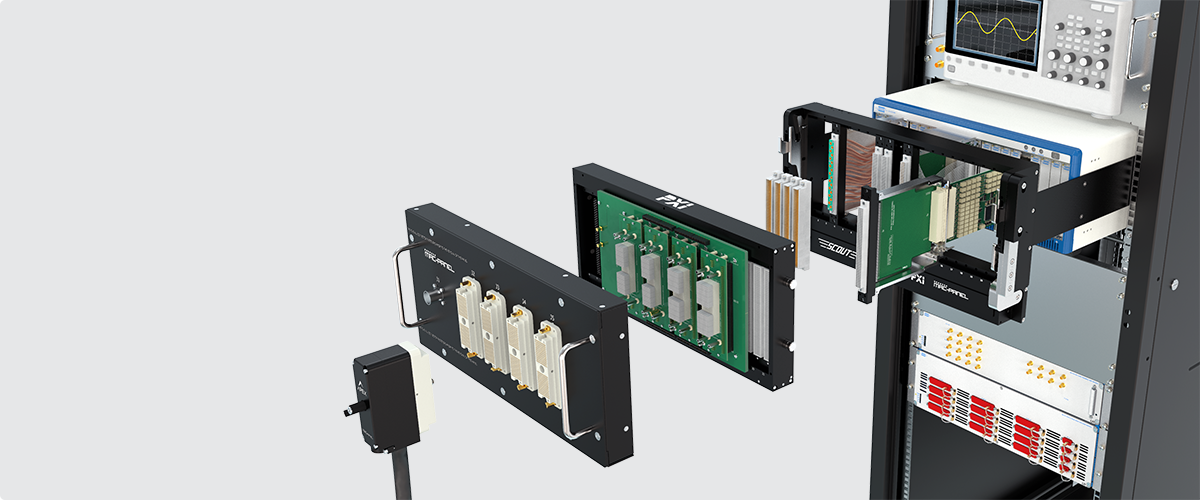
SCOUT is MAC Panel’s flagship mass interconnect system, designed for high-performance, modular Automated Test Equipment (ATE) setups. It is especially suited for Battery Management System testing, where flexibility, reliability, and scalability are paramount. One of SCOUT’s key innovations is its use of Direct Access Kit (DAK) technology.
What is DAK Technology?
SCOUT utilizes DAK technology, which eliminates the need for traditional wiring by providing direct connections between the PXI instruments and the Device Under Test (DUT) through printed circuit boards (PCBs), flex circuits, or short wire links. DAK technology reduces the physical distance between instruments and the DUT, resulting in enhanced signal integrity and a more reliable test environment. This direct access setup minimizes signal loss, reduces electromagnetic interference (EMI), and ensures that high-fidelity signals reach the DUT, making it ideal for high-precision applications like BMS testing.
In essence, DAKs bridge the test instruments and the DUT, offering a cleaner, more efficient connection path. They streamline the testing process by ensuring seamless integration of instruments, reducing the need for complex, error-prone cabling. This is particularly important for BMS tests, where high-frequency, high-power signals must be accurately measured.
Turnkey ITA Solutions for BMS Testing
In conjunction with DAK technology, MAC Panel offers turnkey Interchangeable Test Adapter (ITA) solutions specifically designed to provide a flexible, scalable platform for BMS testing.

What Are ITAs?
Interchangeable Test Adapters (ITAs) serve as the interface between the test system and the DUT. ITAs house the connectors and signal routing that enable different test instruments to be connected to the DUT. They are designed to be swapped in and out easily, allowing for fast transitions between different test setups without needing to reconfigure the entire test system. This feature is particularly beneficial in environments like BMS testing, where different battery configurations may require distinct testing protocols.
The flexibility of ITAs lies in their ability to support various types of connections—voltage, current, temperature, and communications—without the need for rewiring. ITAs enable seamless transitions between tests, improving efficiency and reducing the likelihood of human error.
Types of ITAs:
PCB ITAs: These ITAs use printed circuit boards to route signals directly from the test instruments to the DUT. This eliminates traditional wire harnesses and ensures a highly reliable, low-maintenance solution. For BMS testing, PCB ITAs offer:
- High Signal Integrity: With fewer wires and cleaner connections, signal degradation is minimized, ensuring accurate test results.
- Fast Reconfigurations: PCB ITAs allow for quick and easy swapping of test configurations, which is critical for production environments where multiple BMS setups must be tested in parallel.
- Compact Design: PCB ITAs offer a space-efficient design, making them ideal for test environments where rack space is at a premium.
Hybrid ITAs: Combining the best of both worlds, Hybrid ITAs use a mix of PCB technology and traditional wiring. This configuration allows for greater flexibility, supporting both high-density signal routing and high-power connections. For BMS testing, Hybrid ITAs are particularly useful when:
- High-Power Testing: Hybrid ITAs support high-current, high-voltage applications, allowing them to handle the power requirements of modern electric vehicle batteries.
- Custom Configurations: The hybrid approach allows for the adaptation of the test setup to handle different types of signals, such as voltage, current, and temperature, without sacrificing signal integrity.
Advantages of Using SCOUT with ITAs for BMS Testing:
- Efficiency: SCOUT’s DAK technology, combined with ITAs, dramatically reduces the time required for test setup and reconfiguration. This is crucial for production environments where downtime must be minimized.
- Scalability: ITAs can be swapped out to accommodate different battery configurations, making the system highly scalable and future-proof for new BMS designs and battery chemistries.
- Improved Accuracy: By reducing the number of traditional cables and improving signal routing through PCBs, SCOUT ensures high-precision measurements, which are vital for verifying BMS functions like State of Charge (SoC) and thermal management.
- Adaptability: With interchangeable ITAs, SCOUT can handle a wide range of test scenarios, from high-frequency signal monitoring to power cycling and fault insertion.

Why SCOUT Is the Ideal Solution for BMS Testing
SCOUT’s DAK technology and Interchangeable Test Adapters (ITAs) make it the perfect solution for both R&D and production BMS testing. The system’s ability to support rapid reconfiguration, high-density connections, and precise signal management ensures that it can adapt to the evolving needs of battery testing.
For BMS applications, where multiple parameters—such as voltage, current, temperature, and communication protocols—must be monitored and tested simultaneously, SCOUT provides a reliable, modular testing platform that reduces complexity while improving overall system performance.
Summary
Battery cell simulation in an industry-standard open platform is the safer, more cost-effective, flexible, modular and scalable option to ensure controlled and precise testing. The combination of Pickering’s PXI-based switching and simulation expertise and MAC Panel’s SCOUT mass interconnect system enhances flexibility and accuracy in both R&D and production environments.
About MAC Panel
Since 1958, MAC Panel has been a leader in providing high-performance connectivity solutions for automated test equipment (ATE). Serving industries such as aerospace, defense, automotive, and medical, we specialize in advanced mass interconnect systems, small I/O connectors, and custom wiring services. Our innovative products, including the SCOUT PXI Interconnect Solution and APEX connectors, are designed to enhance testing efficiency and reliability. At MAC Panel, we are committed to delivering tailored solutions that reduce testing costs and ensure dependable performance for our customers’ critical applications.
For more information on high-performance connectivity, please visit macpanel.com
About Pickering Interfaces
Pickering Interfaces designs and manufactures modular signal switching and simulation for use in electronic test and verification. We offer the largest range of switching and simulation products in the industry for PXI, LXI, and PCI applications. To support these products, we also provide cable and connector solutions, diagnostic test tools, along with our application software and software drivers created by our in-house software team.
Pickering’s products are specified in test systems installed throughout the world and have a reputation for providing excellent reliability and value. Pickering Interfaces operates globally with direct operations in the US, UK, Germany, Sweden, France, Czech Republic and China, together with additional representation in countries throughout the Americas, Europe and Asia. We currently serve all electronics industries including, automotive, aerospace & defense, energy, industrial, communications, medical and semiconductor. For more information on signal switching and simulation products or sales contacts please visit: pickeringtest.com/BMS.


