
Contents
17 Jul 2025 • 8 minutes
Five Tips for Designing Scalable Automated Production Test Systems
Discover how planning for production test and selecting the right switching solution early in the design process will reduce your test times and unit test costs while increasing test accuracy.
|
As demand increases or you modify products by adding new features or developing new models, what happens to your test system? Will it scale to meet your new testing requirements? Or are you scrambling to put together a budget to develop a new test system? Too often, it’s the latter, as many production test systems are designed only to meet the requirements of the product being tested now, without considering future test needs. Developing test systems that meet just a small subset of your long-term test requirements happens for a variety of reasons – budget restrictions, staff limitations, and ingrained internal policies and procedures. Instead of staying trapped in this pattern, you can reduce long-term unit test costs and keep production running by planning for a forward-looking, scalable, and flexible automated test system. This will allow you to easily adapt to changing requirements with minimal additional investment and downtime. |

|
In this white paper, we explore five tips for developing scalable manufacturing test solutions that will best fit your long-term requirements and support your growth plans. We also discuss how switching plays a huge role in building scalable functional test solutions that can perform tests faster and with higher accuracy; how considering switching early in your test plan can lead to many long-term production benefits; and how Pickering's experts can help you design an optimal, scalable switching solution.
Tip 1: Design for Test
To develop test systems that can evolve as production needs change, you must begin with the end in mind – your final tested product. In short, designing for production test is all about ensuring your R&D team considers your final testing needs as early as possible during the design process. To do this effectively, test engineers from both R&D and test need to be involved in initial design discussions.
Involving test engineers during the design phase can help avoid the common problem of test requirements being imposed by engineering without early communication. This early collaboration helps prevent situations where test specifications are later found to be impractical, infeasible, or difficult to execute.
Additionally, when you design for test, your R&D and test teams are at the table together at the beginning of the design process. This means you can develop a comprehensive test plan early on that determines realistic budgets for R&D versus test and plans for reusability between your test teams (covered in more detail later).
To ensure your automated test system is designed for scalability and is flexible enough to be reused across multiple programs during these early discussions, you'll need to consider the design of your signal switching subsystems, which are typically designed last. By considering your signal switching early and designing your test solution from the inside out, you can save time and money by standardizing core electronics test and measurement platforms along the way.
Designing for test is all about ensuring your R&D team considers your final testing needs as early as possible during the design process.
Discussion Questions to Help Design for Test
- Will the operator have to probe the unit under test (UUT) during the test process? If so, are there easily accessible test points?
- What operator safety factors, such as unprotected voltage points, need to be considered?
- If the UUT has a large capacitor, how should it be discharged before removing the UUT from the test fixture?
- Are there internal diagnostic routines embedded in the UUT? If so, is it beneficial to the test program to implement them? How does the test system initiate the internal diagnostics? And how does the test system read back the results?
Tip 2: Leverage Established R&D Test - But Don’t Replicate it
|
As mentioned, when your R&D and test engineers are talking early in the design process, you can also consider how to reuse equipment and tests developed for R&D during manufacturing test. While your R&D team requires highly precise and more expensive instrumentation to fine-tune signals and validate designs, your test team is more interested in instrumentation that can validate your manufacturing process as quickly and efficiently as possible. For example, you may need a highly accurate vector network analyzer (VNA) to fine-tune signals in the lab.
Still, a less sensitive, lower-cost option is likely suitable for verifying that products are manufactured
correctly. Even though you are using different instruments, if you plan accordingly during design, you
can reuse algorithms and software routines from R&D to production, reducing overall test costs and
the time required to develop the automated test system.
|

|
Tip 3: Think Beyond Your Current Production Test Needs...
...Well Beyond
When a test system is designed solely for specific product and process needs without considering future testing needs, the result is a rigid test system that cannot scale as your test needs evolve. This is problematic because it contradicts how you run a business, where you are always planning to grow. Instead, if you plan for a scalable functional test system from the beginning, your test system will be designed to grow with production needs throughout your entire production (not just product) lifecycle, evolve with requirements, and scale with overall growth.
If you are planning more than one iteration of your product or plan to test multiple units with a single test system, you should consider using a modular hardware platform, such as PXI (learn more about PXI in our PXImate book), with an automated switching solution. A test system built on this modular platform is inherently scalable, enabling greater test flexibility as you grow and products evolve.
You can also plan to add new test capabilities or augment existing test assets by using flexible software along with the modular hardware. For example, using interchangeable virtual instrument (IVI) drivers will allow you to increase the performance and flexibility of your test instruments by defining advanced features such as instrument simulation, state caching, automatic range checking, and multithread safety. Using IVI drivers can also reduce the time and effort needed to integrate measurement devices into new or existing systems by providing interchangeability. Therefore, we highly recommend checking with your instrument/switching vendors to see if they support IVI.
Discussion Questions to Help Plan for Long-Term Production Needs
- What is the intended lifecycle for this test system, not just for this one UUT?
- Are there already planned iterations for the UUT that will need to be tested?
- Do you want to test more than one product with this test system?
Planning for long-term production requirements also means considering what long-term vendor support will look like for the components required for your test system. Select components from vendors that plan for long-term support to avoid obsolescence. Or you can adopt a vendor-agnostic hardware platform (like PXI) from the start, which will not lock your test system into a specific test framework if an instrument or switch becomes obsolete. This approach will also help you save time when developing your test platform, since your test engineers will not need to learn proprietary architectures or communication interfaces that will not easily scale as systems evolve.
Tip 4: Automate, Automate, Automate
One significant difference between R&D and production tests is that most R&D tests are performed manually because testing requirements change frequently as the product evolves rapidly. As you move into production, and test throughput becomes the focus, automated testing is a must. Test automation not only accelerates testing but also increases test accuracy by eliminating human error and the risks associated with manual test intervention.
But maximizing production, test system automation starts with decisions you need to make very early on, such as the application development environment you select. You need to be sure it can scale well and that there are readily available software drivers for the various hardware platforms you are using.
Another key component for automation is your switching subsystem. With a well-designed switching subsystem, you can optimize your test system for execution time, enabling you to get as much product through the pipeline as possible. Switching also enables more advanced testing options, such as bulk insertion testing and hardware-in-the-loop (HIL) simulation. You can also test multiple devices in sequence with proper switching, and take more measurements in a finite amount of time with fewer errors.
Tip 5: Increase Uptime by Planning for Preventive Maintenance of Production Test Systems
Just like a car needs regular oil changes and maintenance to prevent a breakdown, your production ATE also needs routine preventive maintenance to avoid unplanned downtime.
The goal of preventive maintenance is not to identify something that is already broken; that would be reactive maintenance. Instead, preventive maintenance aims to identify inefficiencies that, if left unaddressed, could lead to larger problems.
The frequency of your regular self-test routine should be based on how often the test system is used. For example, after 10,000 tests, your maintenance plan may require you to perform diagnostics to verify that your switching is still functioning optimally. Therefore, your preventive maintenance plan could include a routine to characterize your switch modules for signs of degradation. If you notice a change in path resistance over time, it's a good indicator that a mechanical relay may be likely to fail, and you can address it before it leads to a production-halting problem.
Developing a Scalable Production ATE by Planning for Proper Switching
Now that we have discussed some general tips for designing your automated test platform for long-term test system flexibility and scalability, let’s look more specifically at the many benefits of properly planning your switching solution early in the design cycle. As mentioned throughout this paper, when you intentionally begin a production ATE design with signal switching in mind, there are several benefits you can bring to your production floor.
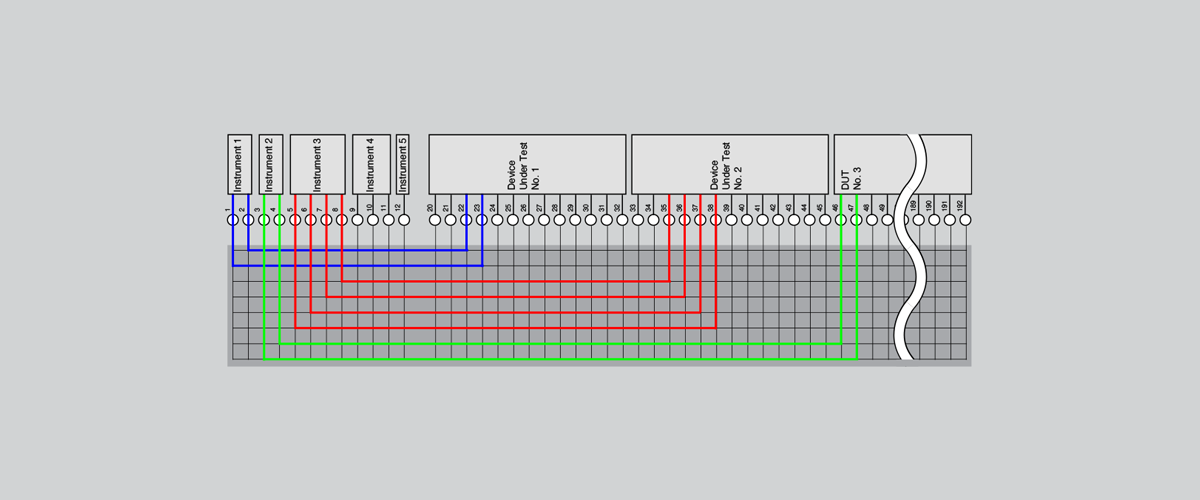
In general, a properly planned switching system allows you to increase throughput while reducing the number of test instruments needed. If you were facing production limitations due to a lack of space on your plant floor, a test system with a smaller footprint could allow you to add more test units, increasing throughput. Having fewer instruments can also help reduce the amount of time and money required for test system maintenance, since there is less hardware to maintain and calibrate. While we acknowledge that using an automated switching system requires mechanical relays, which can fail, these failures can easily be identified through proper preventive maintenance, as discussed above.
When using Pickering switches specifically, if you experience a test system fault, you can use our BIRST (Built-in Relay Self-Test) and eBIRST diagnostic test tools to quickly isolate the switching module from the rest of the system and measure contact resistance to determine if there is a fault with the relay. This will help you quickly identify issues with your switching so you do not waste time debugging other parts of the system.
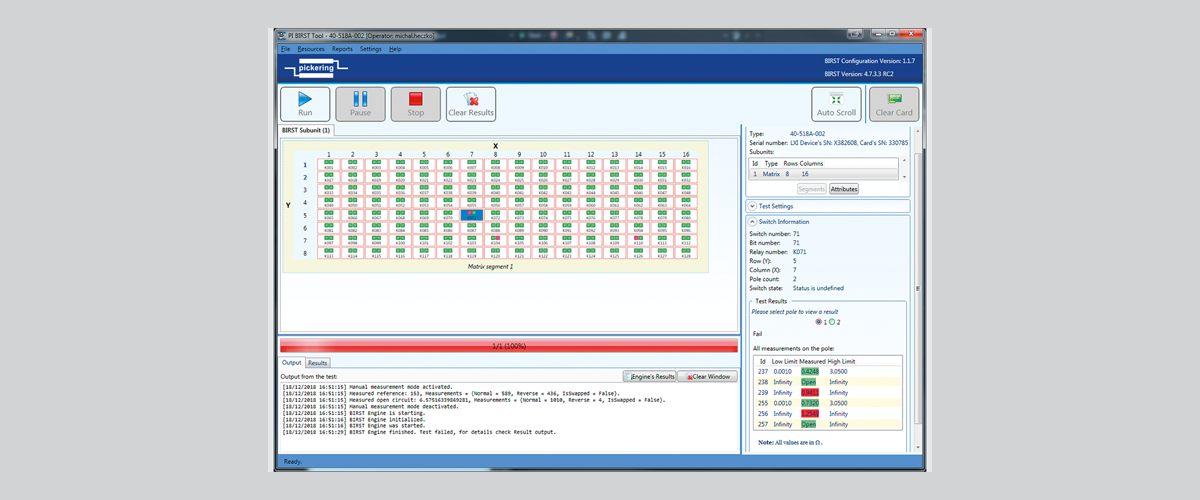
Since a well-designed switching system enables faster testing, you can either increase throughput and get more product to market faster, or reduce overall test costs by reducing the number of testers you need to reach your target production volume. With this in mind, when considering test system design options and calculating your test cost, you should not focus solely on the initial cost of your test hardware – this is not a true reflection of your test cost per unit; it is your capital expenditure. Test costs are accrued over the life of a program and will increase if you have a test system that requires frequent maintenance or if you do not plan for automation and scalability from the beginning. By designing a switching solution that enables you to test more units faster and easily supports future expansion, you will greatly reduce your test cost per unit.
Selecting the Right Approach for Your Production Test Switching Needs
There are many nuances to switching that, when fully understood and considered, can optimize your manufacturing test solution.
Switching is often an afterthought in many test systems because, at its most basic level, it is a very simple concept – the switch is either open or closed, allowing a function to occur or not. But in reality, there are nuances to switching that, when fully understood and considered, can optimize your test solution. This includes making decisions such as which relays and cables to use, and ensuring that connectors, cables, switching, and instruments are impedance matched based on the signal types you are switching. Understanding all these variables requires the in-depth switching expertise of Pickering engineers.
|
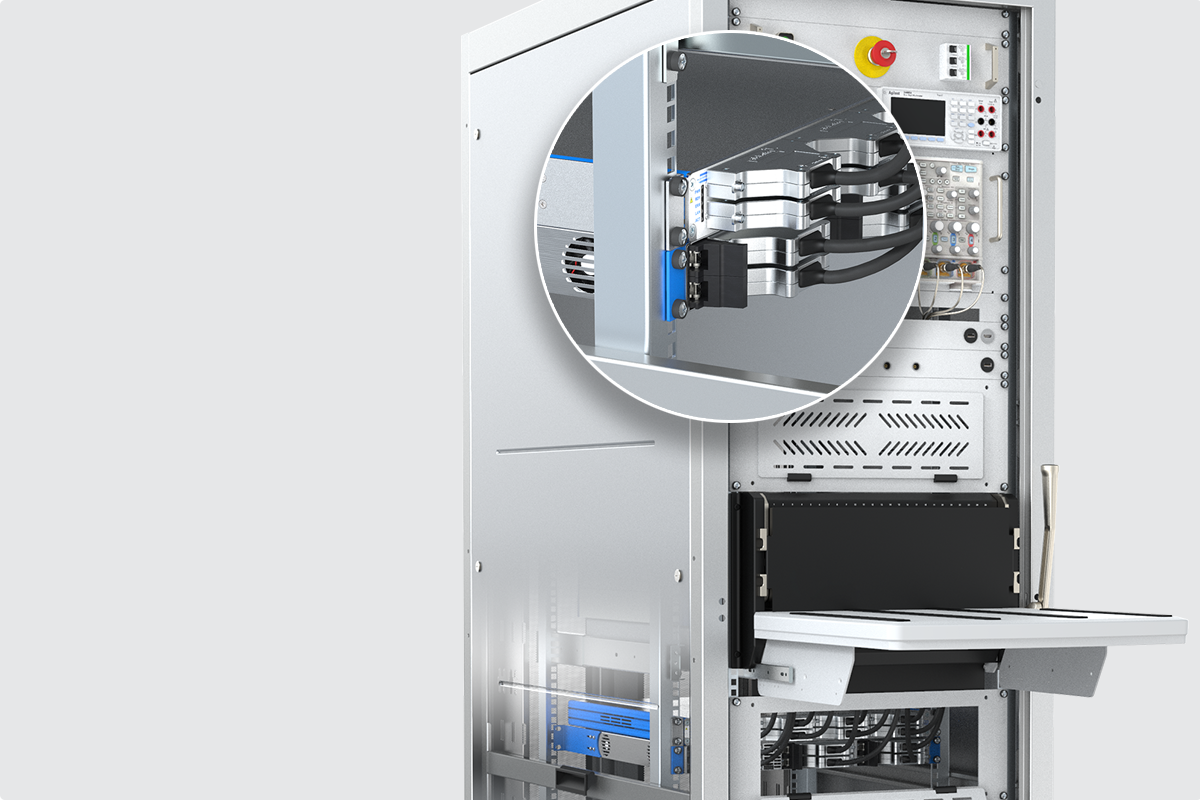
At Pickering, we know that even though we have more than 1,000 switch modules available, an off-the-shelf solution still does not exist for every single test need. Instead of providing “good enough” switching options, our engineers are available to discuss your production ATE needs and develop switching specifications that will give you exactly what you need. We can cost-effectively create customized switching modules by modifying a commercial off-the-shelf (COTS) switch that is close to meeting your needs, or we can develop fully custom options when needed. We also reduce the typical risks associated with using a semi-custom or custom solution by continuing to use open standards, making the customized switch a catalog item, and providing the same long-term support for these solutions as we do for our COTS modules. |
|
Partner with Pickering to Future-Proof Your Production ATE
Develop a solution that will address both your current test needs and easily and cost-effectively scale to meet future requirements you may not even have in mind yet.
By planning to use some of the tips discussed above and building your test system with future production needs in mind, you will be well-positioned to cost-effectively scale your test equipment as test needs evolve. And while we know that test can be an afterthought during product development, for us, test is our every thought. By selecting Pickering to assist you with switching system development for your production ATE, our engineers will help you plan to move from R&D to manufacturing test with confidence. We will collaborate with you to build a modular, vendor-agnostic switching interface that is fit to spec, seamless to integrate, and built to last. This switching subsystem will be part of your production ATE’s flexible foundation, helping you develop a solution that addresses your current test needs and scales easily and cost-effectively to meet future requirements you may not even have in mind yet.
We also recommend trying out our Test System Architect, a powerful, free-to-use, online graphical toolset for intuitively designing, managing and visualizing all aspects of test system switching and signal routing, with precision and efficiency.


