
Contents
23 Feb 2024 • 9 minutes
The Case for Modularity in Test Systems: From NPI to Mass Production Test
Discover how modular test systems and PXI solutions improve product lifecycle testing. Learn strategies for optimized, cost-effective validation and seamless integration.
Introduction
When it comes to designing and manufacturing automated functional test systems, today’s engineers find that modularity is key. By using modular hardware, organizations can more effectively manage test equipment from new product introduction (NPI) through to mass/high-volume production.
Automated test systems have different demands throughout the product lifecycle. First, products are part of a new product introduction (NPI) phase where engineers verify design requirements. Then, products move to a mass production phase where test systems validate the product. And finally, products evolve or become obsolete, requiring test systems to be modified or equipment to be reused for new endeavors.
By understanding the key issues at every phase of the product lifecycle, organizations can make decisions that result in flexible, reliable, scalable test systems. Taking a modular approach to system development using a long-term partner helps organizations accelerate development and mitigate risk throughout the entire product life cycle.
What are Modular Test Systems? A modular test system usually consists of a computer-controlled chassis that houses multiple instrumentation and switching modules that can be interconnected to form a complete automated testing solution. PXI has become the most globally popular modular hardware platform for electronic test, measurement, and automation applications.
Why is PXI ideal for modular systems? PXI is a short form for the PCI eXtensions for Instrumentation bus standard. Introduced in 1997, it is an industry-standard, chassis-based architecture that defines how instruments, computers, and other devices can be interconnected using a common bus. PXI systems use the PCI or PCI Express buses to interconnect the various modules in the chassis. PXI is a rugged, high-performance platform that is well suited for applications requiring tight timing and synchronization between modules. It offers an extremely wide range of module types from leading global T&M vendors and can be easily expanded with additional chassis and racks.
Phase 1: Designing Test Systems for New Products
1.1. Key Considerations When Creating Test Systems for New Products
As products move through their lifecycles, organizations face different challenges. In the early stages of new product introduction (NPI), for example, there is a need to quickly and efficiently test the product to verify design requirements. This can be best accomplished by taking into consideration the following:
Bridge the Gap Between Design and Test Engineers
One of the easiest ways to ensure an effective and efficient test system is to consider test early in the product design phase. Design engineers are often looking for designs to fulfill the product requirements without taking into consideration how difficult the product will be to test. By bringing test engineers into the discussions early, they can advise on any testability that may need to be added into the product design.
This conversation should look at all products the test system will need to test, including if possible potential future product enhancements and new designs. This will help to ensure the test system design incorporates the necessary flexibility and scalability to efficiently handle these future requirements.
Evaluate Ease of Use and Adaptability of Test Equipment
Once the product spec and test expectations are set, it’s important to get a test up and running quickly. Fast development and deployment of the test system allow engineers to verify the product and move forward as quickly as possible.
At the first run of a test system, issues may arise. As the debugging process takes place, erroneous connections can damage switching subsystems, so being able to quickly diagnose and repair switch failures is imperative to keep the testing process moving forward. By using flexible test equipment, engineers can quickly adapt the test system to design changes without having to completely redesign it.
Pay Attention to Equipment Cost and Availability
Cost and availability are always important, but engineers are often thinking only of the verification testing needed in product development. If a product grows and scales and requires the same test system design for high volume production test, it may require repeat purchasing of extremely expensive or minimally available components, which may cause cost and time overruns in the future.
1.2. The Case for Modular Test Systems in Phase 1
Designing a new test system as early as possible in the product design process and basing it on an industry-standard modular architecture will help organizations succeed in the considerations above. Modular test systems are easy to reconfigure and adapt, meaning they can be quickly adapted to meet changing needs as a product is being defined.
Modular systems are easier to reconfigure and expand than traditional fixed-architecture systems. This flexibility can save considerable time and effort as products evolve, as well as provide the ability to easily adapt the system as application requirements change.
And, beginning with a platform like PXI doesn’t tie an organization to a specific vendor – instead, they can mix and match the best performing components as needed. Similarly, modular systems don’t tie an organization to a specific programming interface, allowing engineers to use their preferred platform and tools, including graphical programming and automated signal routing.
1.3. Pickering’s Expertise in Testing New Products
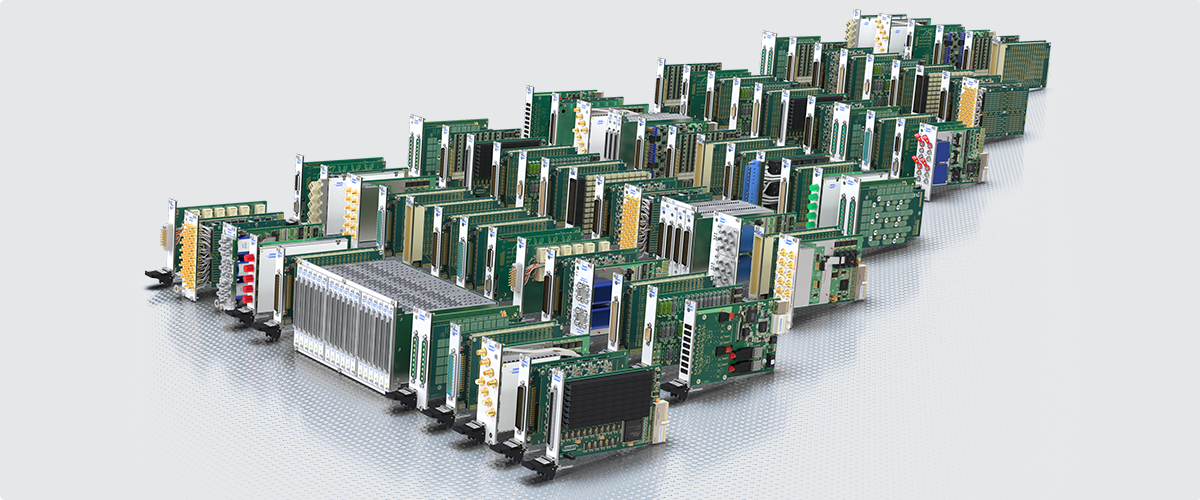
Pickering Interfaces comes alongside clients as early as initial product concept development to advise on test system design early. With more than 1000 off-the-shelf PXI modules, the option to modify existing products to meet specific system needs, and decades of experience helping customers build test systems, Pickering offers a clear path to designing a system that will set an organization up for success from the start with a strong test philosophy and architecture.
With Pickering’s Simulation Tools, engineers can speed the test system design process by beginning even before the test hardware is delivered. Similarly, Pickering’s signal routing softwarehelps to speed test development by reducing switch programming to simply connecting system endpoints together. And Pickering’s web-based Cable Design Tool enables engineers to graphically design custom cables and plan integrations with existing interconnect. Collectively, these tools lower the barrier to getting started with a PXI-based solution.
Phase 2: Moving from NPI to High-Volume Testing
2.1. Key Considerations for Test Systems when Moving to High-Volume Testing
When products move from the validation testing required for an NPI to the production testing required of multiple finished products, engineers are no longer looking for product design faults, they’re looking for component or manufacturing faults. A wellplanned NPI test system can evolve and scale to production testing if it is designed with the following in mind:

|
Consider Available ResourcesFootprint, cost, and component availability are all important when moving to a production test system. In the NPI phase, engineers are working with a full test bench, providing adequate space for equipment. On the production floor, space is limited. Component cost and availability also have implications on production testers – where an organization may need one tester for NPI, they’ll often need multiple for the production floor – whether 2 or dozens. |
Minimize Product Test Time and Improve Throughput
For high-volume production, it is essential to optimize the productivity of all test processes in order to minimize the number of test systems required to meet production demands. This entails minimizing the setup and test execution time of each test system. The device under test (DUT) must be able to quickly and reliably connect and disconnect from the test system so that time is not wasted between units as they move through the test system.
This requires reliable interfacing and possibly even the incorporation of mass interconnect for products with particularly high changeover rates. In these cases, all connections are made simultaneously via reliable, high-usage connectors in a standard streamlined interface.

Operation and Integration Requirements
Test systems must be reliable and quick to repair if a fault develops in order to minimize any adverse impact on production. Also, because production testers are often handed off to be operated by technicians in completely different locations, they need to be easy to operate and well-documented. Similarly, production testers may need to integrate with factory management systems. Industry-standard controllers and programming interfaces will help to facilitate these objectives.
2.2. The Case for Modular Systems in Phase 2
In the production test phase, a standard modular platform typically has an architecture capable of maximizing throughput - for example, all PXI instrumentation and switching modules are integrated into a single chassis with built-in high-speed timing and synchronization, and standard embedded or remote controllers can be easily upgraded to faster models as they become available. Using a platform like PXI also provides the opportunity for parallel testing on more than one DUT as instrumentation can be readily duplicated in the same PXI chassis, potentially further speeding test throughput.
Modular systems also typically provide better value than fixed systems since they offer flexibility, scalability, and reliability benefits while still being relatively easy and inexpensive to develop and maintain, especially compared to fixed systems. The industry-wide vendor support of a modular platform like PXI provides competition that results in best-in-class performance and pricing. And, well supported products from reliable vendors enable access to long-term support for users of modular equipment.
Maintaining PXI-Based Systems: PXI is based on CompactPCI, and it offers all of the reliability benefits of the PCI architecture including industry adoption and COTS technology. PXI adds a rugged CompactPCI mechanical form factor and an industry consortium that defines hardware, electrical, software, power and cooling requirements. As a result, every PXI module has a controlled, stable environment. Modular architecture means that if a module fails, it can be easily tested, swapped or repaired without affecting the operation of the other modules in the system. And as PXI has a standard form factor, chassis are easy to integrate with standard mass interconnect systems available from several vendors.
2.3. Pickering’s Expertise in Moving from NPI to Production Test
Pickering’s teams help clients move test equipment from product design and validation to production and know that these shifts may require changes in test philosophy and involve new stakeholders (and related cost centers). Pickering can work across these various groups to help organizations make the most of their initial test investment from Phase 1. To facilitate the replication of test systems, Pickering can create a custom bill of materials (BOM) for a switching and simulation subassembly and offer custom part numbers for complete systems or offer turnkey switching subassemblies to help companies overcome internal resource constraints.

Pickering offers an extremely effective range of tools and services designed to minimize test system downtime if a fault occurs in one of its products. These range from built-in module self-test tools and readily accessible expert engineering assistance to fast and Pickering’s eBIRST ™ Diagnostic Tool cost-effective factory repair services.
Phase 3: Evolving Test Systems as Products Change
3.1. Key Considerations When Evolving Test Systems Over Time
As products grow and evolve, support will always be a factor – it’s inevitable that a test system will need to be modified or components will require replacement. Because of this, the following considerations set production test systems up for long-term success through the entire product lifecycle.
Minimize the Opportunity for Errors at Every Point
Every duplicated test system should produce the same test results, so engineers should look for quality and consistency of performance across multiple test systems. Interconnect can easily be a failure point as the DUTs are mechanically connected and disconnected. Other points of error can be due to faulty instrumentation, unreliable or mis-matched signal paths that impact signal integrity, or operator error. Regular maintenance checks, knowledge of expected component life, and high-quality documentation all help mitigate these risks.
Use Industry-Standard Tools
When the test system is out of NPI and moves to production, it has to be easy to use and debug, and adapt to design changes. Industry-standard test hardware and software provide familiarity, scalability and flexibility, streamlining the tester deployment.
Work with Reliable Providers
Reliable test equipment vendors and system integrators offer consistent, documented products and tools. Engineers can rely on these providers for long-term support of their products, obsolescence management, and timely updates to enhance the test systems with the latest operating system changes.
3.2. The Case for Modular Systems in Phase 3
Modular systems offer improved scalability compared to fixed systems as it is generally much easier to add or remove modules from a modular system to increase or decrease its capacity. This scalability can be particularly important in applications where test requirements may change over time (e.g., new products added to a manufacturing line).
Typically, PXI vendors have common families of instruments and switching modules, so engineers can seamlessly scale up within that family to add I/O connections, for example. Interconnect accessories for modular instruments are also typically readily available. PXI’s compatibility with mass interconnect provides long-term consistent connection and reduced errors and fault points. And, custom cables can also quickly be designed via easy-to-use graphical tools to meet future connectivity demands.
The PXI Systems Alliance, PXISA, governs the PXI standard, continuing to upgrade its hardware and software and thereby reducing the risk of obsolescence. All of these straightforward upgrades protect the original equipment investment.
This reusable equipment allows organizations to quickly pull together a test set for a similar new product with minimal design effort.
3.3. Pickering’s Expertise in Long-Term Support for Evolving Test Systems
Pickering is known for its commitment to long-term product support. Pickering’s success in growing its modular signal switching and simulation business – most recently achieving 25% YOY growth – hinges on the company’s ability not just to help customers manage obsolescence, but to help them minimize the chances of it occurring.
Additionally, Pickering maintains board-level membership in the PXISA industry consortium and actively helps to govern and maintain the PXI standard.
Pickering’s 3-Pronged Approach to Avoiding Obsolescence:
This approach builds confidence in prospects and has brought customers back to Pickering time and again. Pickering’s obsolescence strategy includes three key factors:
1. Planning for obsolescence during the design phase: Pickering engineering teams evaluate complete test system plans and anticipate upcoming industry challenges to ensure there’s a test solution to meet full product lifecycle demands.
2. Using standardized platforms: By supporting and maintaining more than 1000 PXI and LXI modules and thousands more iterated from those, Pickering offers standard solutions that are more easily evolved.
3. Ensuring ultra long-term support: Pickering commits to support its modules designed into customers’ test systems for their entire lifecycle, even redesigning modules when necessary.
Pickering Interfaces Supports Clients through the Entire Product Lifecycle
Pickering Interfaces designs and manufactures modular signal switching and simulation for use in electronic test and verification. With the largest range of switching and simulation products in the industry for PXI, LXI, USB and PCI applications, Pickering products help customers create successful, modular systems that are flexible, reliable, scalable, and help get products to market quickly.
Pickering offers full production lifecycle support for all products, ensuring that our customers can rely on us for continued support throughout the life of their products. With a team of experienced engineers available to assist with technical queries or issues that may arise, Pickering becomes a trusted, longterm partner for clients. If customers previously standardized on competitor platforms and now face obsolescence without a path forward, Pickering can often adapt modules to match form, fit, and function of the original hardware.
Pickering’s products are specified in test systems installed worldwide and have a reputation for providing excellent reliability and value. Read more about why clients choose Pickering as a test provider at any stage of the product lifecycle: pickeringtest.com/whypickering.


