
Contents
05 May 2022 • 12 minutes
How to Build Successful Switching Systems for Mission-Critical Test Applications
Understand modular switching systems for mission-critical tests. Gain practical guidance on implementing scalable, reliable hardware, system integration strategies, and best practices for hardware validation.
Introduction
Today’s test systems are often developed in silos – specific test systems designed for the specific products or processes needed today – without forethought toward future testing needs. However, shifts in demand require today’s products to scale in production or grow in functionality. When engineering teams design test systems without taking into consideration full product lifecycles or future product roadmaps, they end up with rigid systems and struggle with insufficient capabilities, obsolete components, and ultimately expensive overhauls.
Streamlining your testing can help companies get to market quickly without the stress of technology lock-in, surprise project delays, or ballooning costs.
Furthermore, signal switching subsystems, though at the crux of a test system’s success as multiple aspects of a test system rely on switches to extend channel capability, are typically designed last. This results in final system delays as engineers work to debug signal integrity issues or in switching systems that are hastily specified.
When organizations intentionally begin with signal switching and design their test solution from the inside out, standardizing core electronics test and measurement platforms along the way, the result is a test system that is not only reliable but scalable for growth and flexible for reuse across multiple programs and projects. This is especially applicable for companies who have complex test systems and are looking to streamline test equipment and competencies across engineering teams.
This paper will outline how to design a streamlined switching subsystem at the core of your test system for ultimate:
- Repeatability: able to be easily manufactured and produce accurate, reliable results
- Maintainability: able to be serviced easily
- Scalability: able to grow with product lines and functionality
- Flexibility: able to be reused for future applications

Design Standardized Switching Systems for Reliable, Repeatable Results
As extensions of the test instrument and device under test (DUT) I/O, the switch and associated cabling/interconnects must be precisely specified to ensure a system design meets requirements. With reliable test systems, engineers free themselves from questioning the test system and its ability to produce consistent results. If issues arise, they can have a higher degree of certainty that the failure is the product, not the test system.
As a first step toward building a reliable test system, teams should select the software that will control it. Making this choice early allows engineers to confirm, as they choose hardware, that each component has the necessary level of software support.
When selecting hardware, it’s important to review whether the appropriate software support is provided for the application development environment that will be used. C/C++/C#/LabVIEW/Python are among the most popular, as is a demand for flexibility in OS, i.e., Windows, Real-Time or Linux.
When assessing technical hardware and interconnect requirements, consider:
- What is the power/frequency spectrum to be covered in these tests?
- What is the intended channel count?
- What types of impedance matching are required? Internal diagnostics? And how does the test system read back the results?
Pay particular attention to the insertion loss specification of a switch, which can drastically affect results. When a switch relay closes, it doesn’t always have the same path, leading to variance. Insertion loss of a switch at a particular frequency contributes to total power loss or voltage attenuation caused by the switch on a signal at that frequency. Higher quality relays produce more consistent, repeatable results.
Insertion loss and bandwidth, which are related, are particularly important in applications where there are higher-order harmonics of interest (i.e., rise time or pulse width measurements). A switch with high insertion loss (low bandwidth) can impede harmonics and result in erroneous results.
Pickering’s free Cable Design Tool helps engineers streamline a project. Intended to allow engineers the ability to design, review, and approve custom cable assemblies, it provides a clear path forward to reliable cables.
The tool allows engineers to both accurately specify cables and communicate designs across the organization. With digital designs saved as a future reference, engineers also have a starting point when needs arise for additional cables.Selecting the right products first is also imperative to reliable results. Changing products mid-stream because they don’t meet unforeseen requirements can cause ripple effects in interfacing and software development efforts. Use Pickering’s Product Selection Tool to explore the right products for specific requirements.
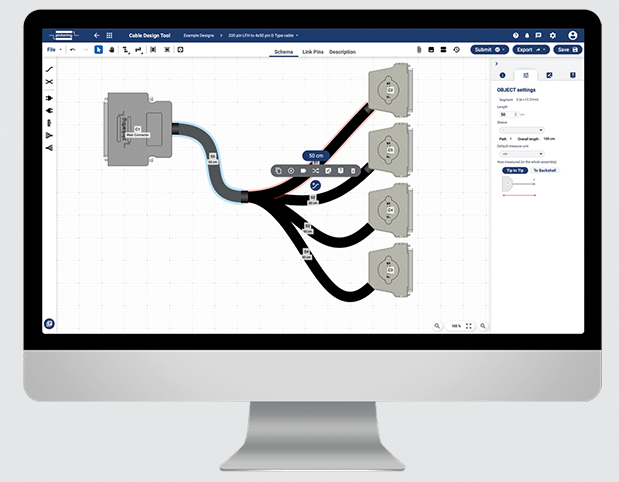
Figure 1. Pickering Cable Design Tool
Design Standardized Switching Systems for Maintainability
While the first priority is designing for reliability, every system will have a maintenance issue at some point in the product lifecycle. Relays are mechanical in nature and will ultimately fail over time. It can be difficult to determine whether a test failure is with a relay, cabling, connector, or mass interconnect. The success of a system hinges on its ability to be serviced easily and back up and running quickly.
Test system issues must be straightforward to diagnose and remedy. Traditionally, engineers must have to first establish which subassembly or module is faulty, then test individual modules to find which relay has failed. This manual process consumes hours of engineer or technician time. Alternatively, teams can write a self-test program to provide a diagnosis, though this approach is also significantly time-consuming and costly as the engineer looks to understand the test system and the design of the switching system and verifies the final diagnosis to avoid failed repair attempts.
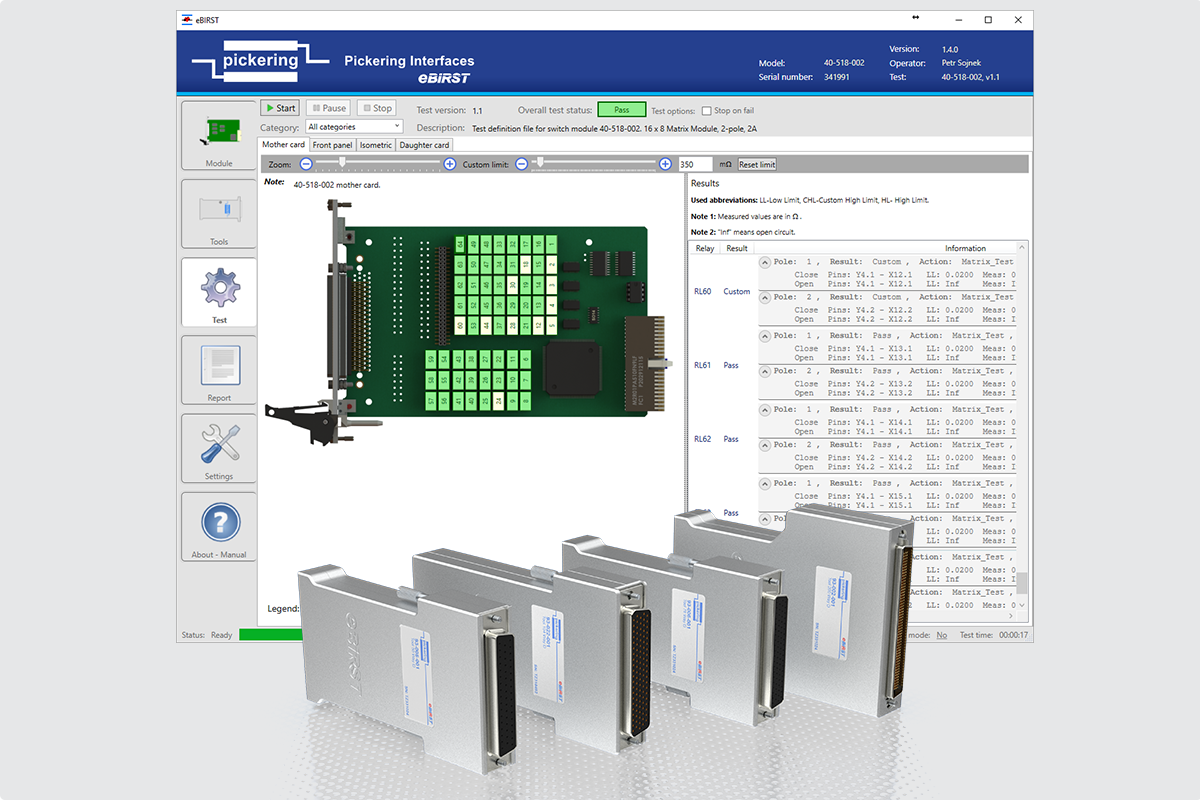
With Pickering’s BIRST (Built-in Relay Self-Test) and eBIRST test tools, engineers can quickly isolate the module from the rest of the system to determine if it has a fault, so time is not wasted trying to debug other parts of the system. These tools don’t require expertise to operate. BIRST is a free, Windows-based software download available for most Pickering LXI and PXI matrix switching systems. eBIRST is a toolset for specific connectors used in a switching system that provide a means of quickly determining if a switching system has faults, identifying where the fault is located and allowing fast corrective action.
Maintainability also requires managing obsolescence – ideally, not only mitigating obsolescence, but avoiding it altogether.
When components of a system become obsolete, teams face substantial costs to re-engineer systems.
Designing out instruments that suddenly become obsolete is an expensive task and can stress a budget. Replacing obsolete components can require additional programming and validation of new testing processes as updated components may not function identically to former ones.
By choosing modular components and proven supported software, teams can ensure backward compatibility if specific components become obsolete. In addition, platform flexibility is key to avoiding obsolescence. Using components like PXI switching modules that can be used in an LXI- or PXI-controlled environment sets the stage for ultimate long-term compatibility. Pickering goes to great lengths to design out component obsolescence while maintaining backward compatibility to help preserve our customer’s up-front investment in our products.
The success of a system hinges on its ability to be serviced easily and back up and running quickly.
How One Pickering Customer Built a Reliable, Maintainable, Scalable, Flexible System, and Used it as the Basis for a New System More than Ten Years Later

Challenge: An organization designing satellite products sought to create a test system that would endure a long product lifecycle.
Why Pickering? The organization planned to base the system on one of two decade-old systems that were still in operation. Pickering still made and supported the products from their prior system, while the competitor system faced a threat of obsolescence. This made the Pickering solution a superior choice – the organization could both reuse the prior designs as a starting point, and be confident they wouldn’t face obsolescence issues.
Solution: Pickering provided a PXI switching and hybrid chassis + custom cabling solution.
Process: Pickering opted for a hybrid chassis because it would allow for future integration of PXI Express products if needed. All other modules were selected because they matched the existing design, which gave them a proven solution for a very high-density multiplexer solution.
Results:
- Reliability: Using a proven basis for the system created a reliable platform. In addition, Pickering manufactured custom cables to be durable in a challenging environment (long distance between system and DUT).
- Scalability: Moving to a hybrid chassis provided an opening for introducing new technology as many new PXI instruments are released with PXI Express only interfaces.
- Flexibility: Building in capability for PXI Express future proofed the components so they can be reused later.
Design Standardized Switching Systems for Scalability
When designing the switching subsystem for a test system, scalability can take many forms. To begin addressing scalability, consider the following:
- What is the intended timeframe for this test system?
- Are there already planned iterations for the DUT that will need to be tested?
- How many different products will be tested on this system?
Addressing both current needs and possible future capability requirements that your team might have helps organizations futureproof systems with a scalable solution. By finding a test partner who is willing and able to design or modify COTS solutions to meet current and future requirements as needs evolve, test engineering teams get a solution that will scale with their growth.

Software compatibility also plays a role in scaling test as a product line grows. As product lines grow, industry standards can evolve, and software will be required to certify new standards. Streamlined software helps promote interoperability across different vendors’ products (large-scale ATE systems are almost always multi-vendor).
Avionics/defense industries tend to favor PXI and LXI standards as they are easy-to-install solutions. Adopting a vendor-agnostic hardware approach frees test engineers from unnecessarily spending time learning proprietary architectures or communication interfaces that won’t scale well as systems evolve.
With a modular approach, modules can be included in a system build or excluded if they are not needed. Engineers also can take advantage of a range of chassis sizes with varying slot counts, from a 1/2 rack 1U mainframe with 2 slots all the way up to a full rack, 4U 18-slot chassis. And with Ethernet/LAN, it’s easy to add mainframes as needed by plugging the box into an available port on an Ethernet switch in the system.
Developing a Standardized Switching System for Multiple Avionics Platforms

Challenge: A government prime contractor wanted to develop a depot test system that could be used as a foundational solution to address multiple avionics platforms. The system they were replacing was large and featured an expensive and proprietary switching system that did not scale.
Why Pickering? The organization came to Pickering because of its reputation as experts in switching.
Solution: The ultimate solution was to transition from the large legacy system to a new, modular PXI-based system.
Process: The organization used a wide range of PXI switching products, sensor simulation instrumentation, and the Pickering Cable Design Tool.
Results:
- Reliability: The new system required comparable functionality to the legacy switching system in a small footprint – something Pickering could do with existing COTS products.
- Maintainability: The final solution included a mix of proven solutions including general purpose signal and RF switch modules, communication switching, LVDT sensor modules, PXIe hybrid chassis, LXI chassis + cabling.
- Scalability: The system was designed for scalability, which proved helpful – the organization later needed to add additional switching and didn’t have sufficient rack space, so they could easily add on 1U LXI mainframes to house the additional switching modules.
Design Standardized Switching Systems for Flexibility
Selecting equipment that is robust enough to be used over time in different projects and flexible enough to meet different demands future-proofs a technology investment and streamlines technology and domain knowledge needed across an organization.
Considerations for flexible platforms include:
- Will the system design be used for a small subset of products, or is this something that will be deployed in the factory as a standard platform?
- How diverse are the products that will be tested?
- How long will the platform be used as a core for the organization?
- Is having a common platform desirable for training purposes so that an organization is not dependent on knowledge that resides in a few individuals?
Building a system with future systems in mind allows engineers to reuse equipment. Over time, engineers using modular solutions can swap and reuse instrumentation as projects change.
Standardizing Your Switching System with Pickering
Pickering helps clients move from R&D to production test with confidence using modular switching interfaces and simulation solutions that are fit to spec, seamless to integrate, and built to last. With a focus on high-density signal switching and the availability of key products, including power, microwave and signal switching in discrete, multiplexer, and matrix topologies, Pickering teams can create switching solutions that are reliable, maintainable, scalable, and flexible.
Organizations can use the more than 2000 PXI or 400 LXI COTS products from Pickering, or engage expert Pickering teams for guidance or fully outsourced builds.
Outsourcing is a fit for companies looking to contract an expert partner to plan, design and build the full switching subsystem and is ideal for companies lacking the time and resources to take the do-it-yourself approach. Even when a company builds and manages its own ATE, switching systems can have such intricate requirements that it may be easier to outsource the switching subsystem and procure a solution that will last for 10+ years than to acquire the system design domain knowledge internally.
Outsourcing is particularly helpful when timelines are critical, and organizations need a switching solution up and running quickly or when there’s a possibility of build-to-print systems in the future as a product scales. An outsourced provider can create a switching subsystem with reproducibility in mind to future-proof your operations.
Considerations Before Outsourcing:
- What is the schedule to have a test system operational?
- What is the project budget?
- Are you modifying an existing test system or creating a new one?
- Has a specific industry standard been specified for the system (PXI, LXI, etc.)?
- What specifications will you be testing?
- Do you need to accommodate any legacy hardware or software technologies?
- Will this system need to scale in the future to accommodate expanded requirements?
- Will reuse this system to test additional products?
- Do you have the time, resources, and expertise in-house to design, build, and manage this project?
In this process, Pickering can not only design and build the subsystem, but start from the beginning to help define requirements, and then provide the necessary tools to streamline integration, deployment and ease sustainment and long-term system maintenance.
When Pickering takes on complete switching subsystems, clients can take advantage of many options based on product lifecycle goals:
- Quicker timelines
- Future-proof, flexible and scalable designs
- Mating system interconnect
- Supplied software drivers
- Software support for all major programming languages, including NI software
- Graphical soft-front panels for manual control and monitoring
- Simulation capabilities
- End-to-end switch routing software
- Proprietary diagnostic test tools
- Fully documented components, tested to ensure performance repeatability in subsequent builds/orders
- Worldwide technical hardware and software support infrastructure, including cost-effective RMA repair service.
- 3-year system warranties
- Up to 20-year ongoing support, including free software update
This approach streamlines the development and deployment of high-performance electronic test and verification systems. Companies can scale or repurpose system components in the future as needs, objectives, or requirements change, while remaining as timely and cost-efficient as possible.
Contact us for help selecting components, to get the guidance you need, or to outsource your full switching subsystem.


