
General Purpose Switching Architectures
General-purpose switching refers to a type of switching architecture built using individual relays. These relays can be interconnected to create standard configurations, such as multiplexers (MUXs) or matrices, tailored to specific architectures. They can also be used independently to switch individual signal lines. However, when scaled to form larger, standardized switching systems, they can be relatively expensive and sometimes underperforming. This is primarily due to their low density, which stems from high connector pin usage and the need for external wiring to link the relays.
However, this also makes them highly adaptable, especially when paired with external interconnection systems like mass interconnect solutions, which enable seamless reconfiguration for various applications. As a result, they are a popular choice for test systems that support a wide range of products, helping to reduce the need for multiple dedicated systems.
SPST

Single Pole Single Throw (SPST) switches feature a single input and a single output, functioning in either an open or closed state. In most cases—particularly with reed relays, which are known for their reliability—the relay remains open by default when the switching system is unpowered or in its default state.
However, certain applications, such as Fault Insertion systems, may require a default closed state. This ensures that the connection remains intact even if the switch is reset or loses power.
SPDT

A Single Pole Double Throw (SPDT) switch, also known as a changeover switch, allows a single input to connect to one of two output connections. The input, typically referred to as the "common," can be directed to either the "normally closed" (NC) or "normally open" (NO) output. In diagram, the common is labeled as C1, the NC contact as B1, and the NO contact as A1.
DPST
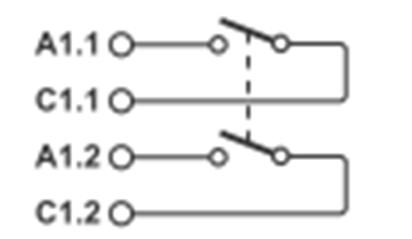
Double Pole Single Throw (DPST) switches have a pair of input and output connections. The two relay paths are either open or closed, if one rely is open then so is the second so the drawing shows a dotted line to indicate the two sets of paths state are linked. As with the SPST the most common default (unpowered) state is to be open but normally closed versions are available.
DPDT

Double Pole Double Throw (DPDT) switches have two changeover switches (SPDT) which are mechanically operated by the same actuator.
Although both contacts are controlled by a single actuator, if one contact becomes welded, it does not prevent the other from functioning. However, the mechanical design may lead to reduced performance on the second contact if the first one is compromised.
Higher Pole Counts
The term "pole" refers to the number of independent, electrically isolated connections a relay can support. Relays are often designed with two poles, as seen in many electromagnetic relays (EMRs), which commonly feature two poles, or in reed relays that utilize two reeds activated by the same coil. When more than two poles are needed, the typical solution involves using multiple relays. These relays can either share a common coil drive (a single control line operating several relays) or be logically grouped, with the driver combining multiple control lines into a single control function.
Safety or Force Guided Relay
Safety relays, though less common in general-purpose applications due to their larger size and higher cost, are specifically engineered to enhance reliability. Their design ensures that if one contact welds, the other contacts remain unaffected, preventing any change in their position. This feature allows the unaffected contacts to monitor the relay's condition and detect if a welding fault has occurred. Some safety relays are equipped with more than two poles to further support this functionality, providing an added layer of security and versatility.
Transfer Switch

Transfer switches are primarily used in microwave switching systems. These four-terminal devices feature two inputs and two outputs, allowing one input to connect to either output while the second input links to the remaining output. In microwave relays, they can also default to an "all open" position, where no connections are established.

