

 Electronics manufacturing and defense contractor functional test teams face rising non-recurring engineering (NRE) costs,
redundant test assets, and rigid test system architectures that can't keep pace with evolving product functionality and
test strategies. To solve this, BLOOMY's Universal Test System (UTS™) family,
integrated with Pickering Interfaces’ PXI
signal switching and LXI/USB chassis hardware, delivers scalable, modular, and hardware-agnostic functional test solutions.
The result: a leading aerospace contractor quadrupled test capacity for less than 10% of its original NRE investment.
At the same time, other manufacturers unified multiple test environments onto a single codebase and standardized testing
across product variants.
Introduction
Functional testing is a fundamental part of product development across aerospace, defense, automotive, medical devices, robotics, and semiconductor manufacturing. And, as products grow more complex, so do the demands on the test systems that validate them. Engineers need to manage a wide range of signal types, ensure hardware and software flexibility and longevity, scale test points rapidly, and control costs, all without compromising reliability.
This case study examines the partnership between BLOOMY and Pickering Interfaces, two established leaders in the test-and-measurement space. Pickering designs and manufactures modular signal switching, simulation, and instrumentation for electronic test and verification. BLOOMY provides automated test solutions for mission-critical and emerging applications throughout the product development lifecycle.
By integrating Pickering's signal path expertise with BLOOMY's advanced UTS technology, the two companies deliver test solutions that adapt to the unit under test (UUT) rather than forcing the UUT to conform to the test system. The following sections outline the challenges of traditional functional testing, the technical approach behind the solution, and three real-world deployments where it reduced NRE costs and eliminated redundancy.
The Problem
Legacy test systems rely on static architectures. Each system dictates which units it can accommodate, rather than adapting to the products it's meant to validate. This architectural constraint creates several recurring problems for test engineering teams:
- Costly Rebuilds: When new product functionality or test system resource obsolescence drive the need for revised test capabilities, engineers must either upgrade existing systems or design entirely new ones. Both paths add engineering demand, extend time-to-market, and increase maintenance costs.
- Redundant Engineering Effort: Maintaining separate test platforms for production, environmental stress screening (ESS), and burn-in testing results in duplicated effort. Any product update requires parallel changes across multiple systems.
- Code Divergence: Multiple codebases for the same UUT drift apart over time, lengthening verification cycles and complicating maintenance.
- Knowledge Attrition: Test systems built for a fixed set of UUTs shorten the useful life of the investment and make knowledge transfer difficult as hardware evolves.
For teams working under tight budgets and low risk tolerance, these inefficiencies compound quickly. What's needed is a modular, scalable hardware implementation paired with test software that adapts without a full rewrite.
The Solution
The core of the solution is straightforward… separate what you measure from how you measure it. When test code describes
measurements from the UUT's perspective rather than dictating specific instruments or switch paths, a single codebase
can serve a product from prototype through high-volume production and into sustainment.
Hardware-Agnostic Test Design with the EFT Module
BLOOMY's Electronics Functional Test (EFT) Module for NI TestStand™ makes this approach practical. However, building an advanced, hardware-agnostic test architecture in-house is no small task and typically requires several seasoned test engineers dedicated full-time to maintain internal tools rather than developing tests. The EFT Module removes that burden as a commercially available software architecture.
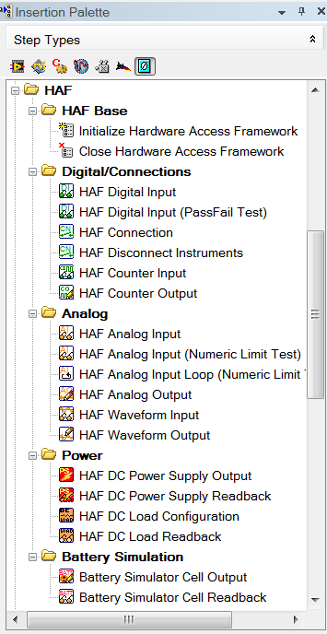
At its center is the Hardware Access Framework (HAF), which provides Hardware and Measurement Abstraction Layers (HAL/MAL). Here's how it works:
- Hardware, connection, and signal configuration settings are managed through custom LabVIEW drivers and stored in a separate HAF configuration file, not in the test code.
- Test sequences reference hardware, signal, communication, and connection aliases created from the UUT's perspective, enabling UUT-driven test design.
- When hardware changes or varies between stations, engineers update only the HAF configuration file. The test software remains untouched.
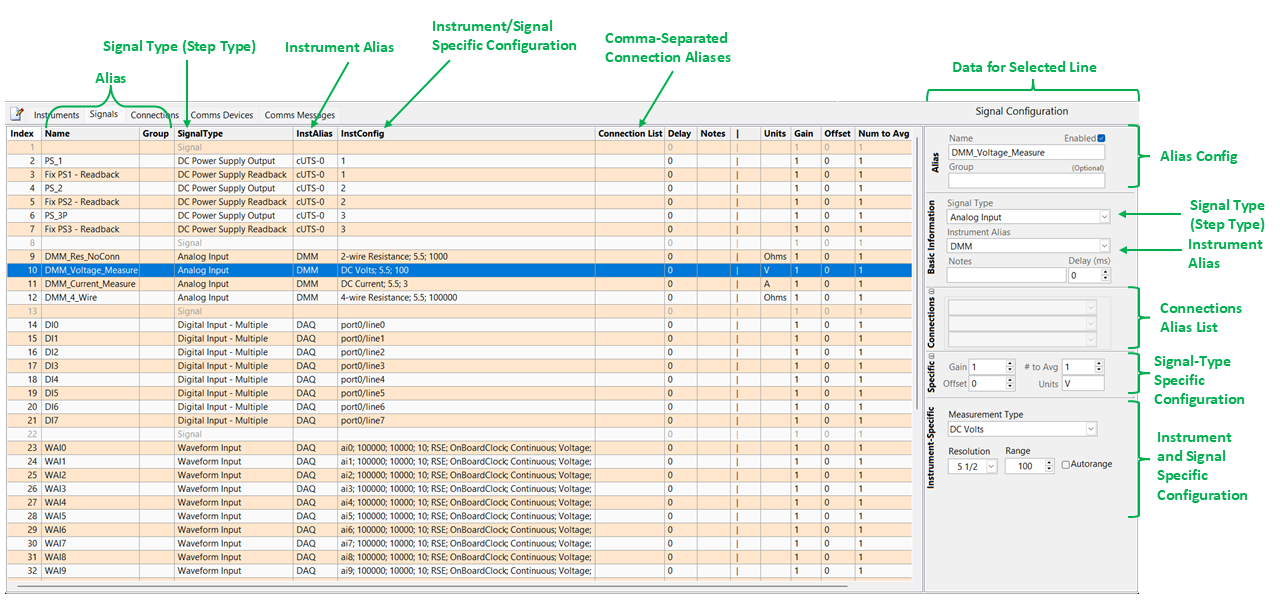 HAF Signal Configuration
This abstraction layer dramatically reduces the engineering required for obsolescence management. A measurement step that reads a digital multimeter (DMM) at specific test points stays consistent even as the switch path or instrument evolves over time.
Pickering Signal Switching as the Routing Backbone
Pickering PXI matrix switching modules, housed either in our low-profile, Ethernet-controlled LXI/USB Modular Chassis ( two-slot or six-slot, depending on system complexity) or a standard PXI chassis, provide the signal routing backbone across every UTS platform. Several factors made Pickering the right fit for BLOOMY's scalable approach:
- Efficient Crosspoint Scaling: The selected Pickering matrix-switching families share identical connector pinouts across columns, with unconnected pins serving as placeholders for additional rows. Because the pinout never changes, operators maintain a single set of manufacturing documents, and customers incur minimal additional NRE as designs evolve.
- Hardware- and Software-Agnostic Integration: Pickering's switching systems integrate with a wide range of test equipment and platforms. A consistent, software-agnostic API lets engineers work with existing and custom solutions without extensive retraining.
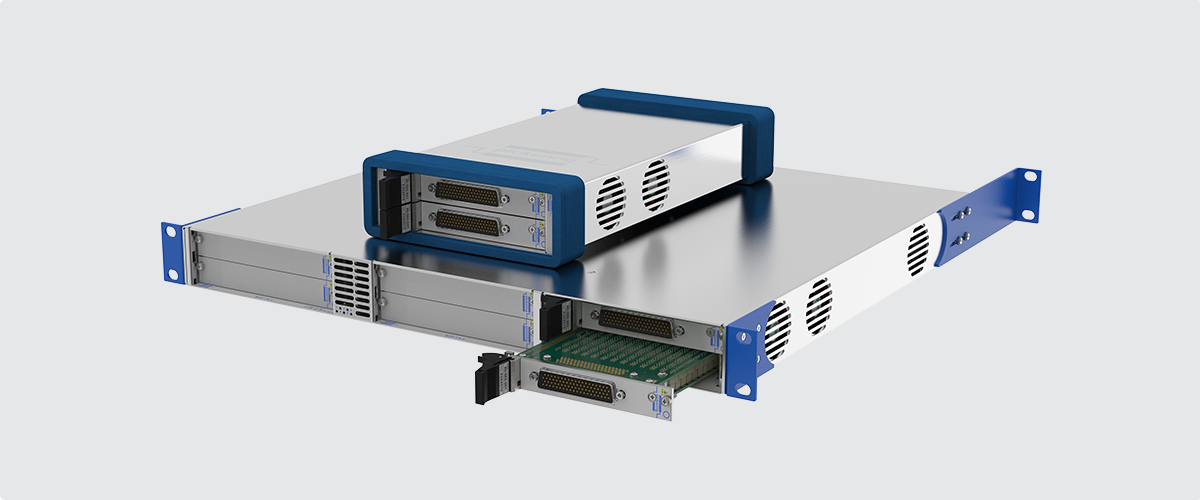
6-slot LXI Chassis with Switching (2x40-585) & 2-slot LXI Chassis with 2x40-585 modules
The UTS Platform Family
Because every platform runs the same EFT-based codebase, test code developed on one system ports to another by updating the HAF configuration file. This lets teams match hardware to where the UUT sits in its lifecycle:
midUTS: Supports 100 to 500 configurable test points via Pickering PXI switching topologies in an LXI chassis. The midUTS is a versatile, cost-efficient test solution for low- to medium-complexity products. Suited to PCBA diagnostics, prototype testing, and RMA repair.
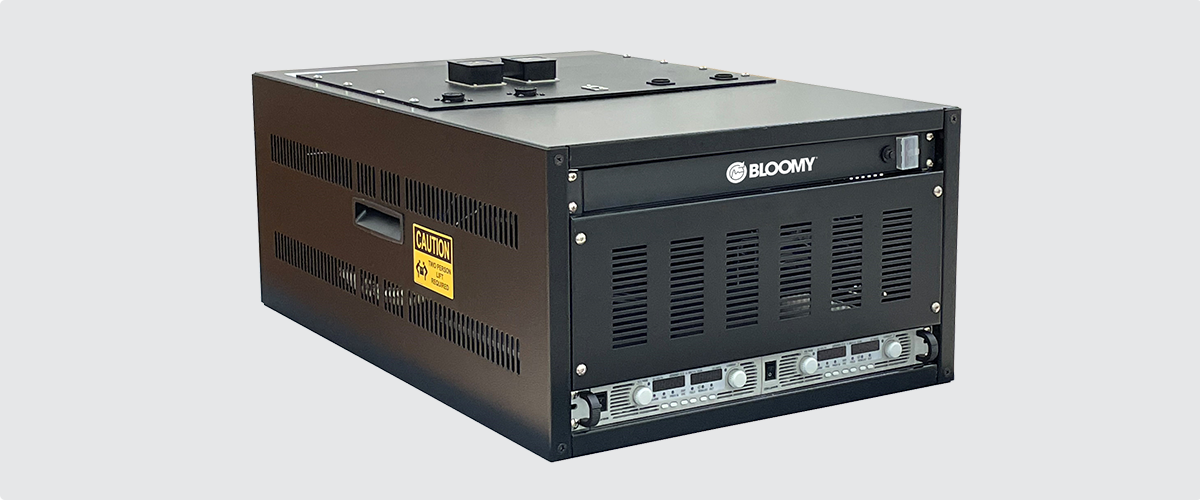
UTS: Scales from 200 to 1,000 test points using Pickering PXI matrices, tailored for demanding production environments where flexibility and fast product changeover in a high product-mix environment is desirable. The UTS architecture can handle increasingly complex UUTs or additional UUTs in parallel without requiring architectural overhauls, thereby reducing time-to-market while maintaining optimal performance.
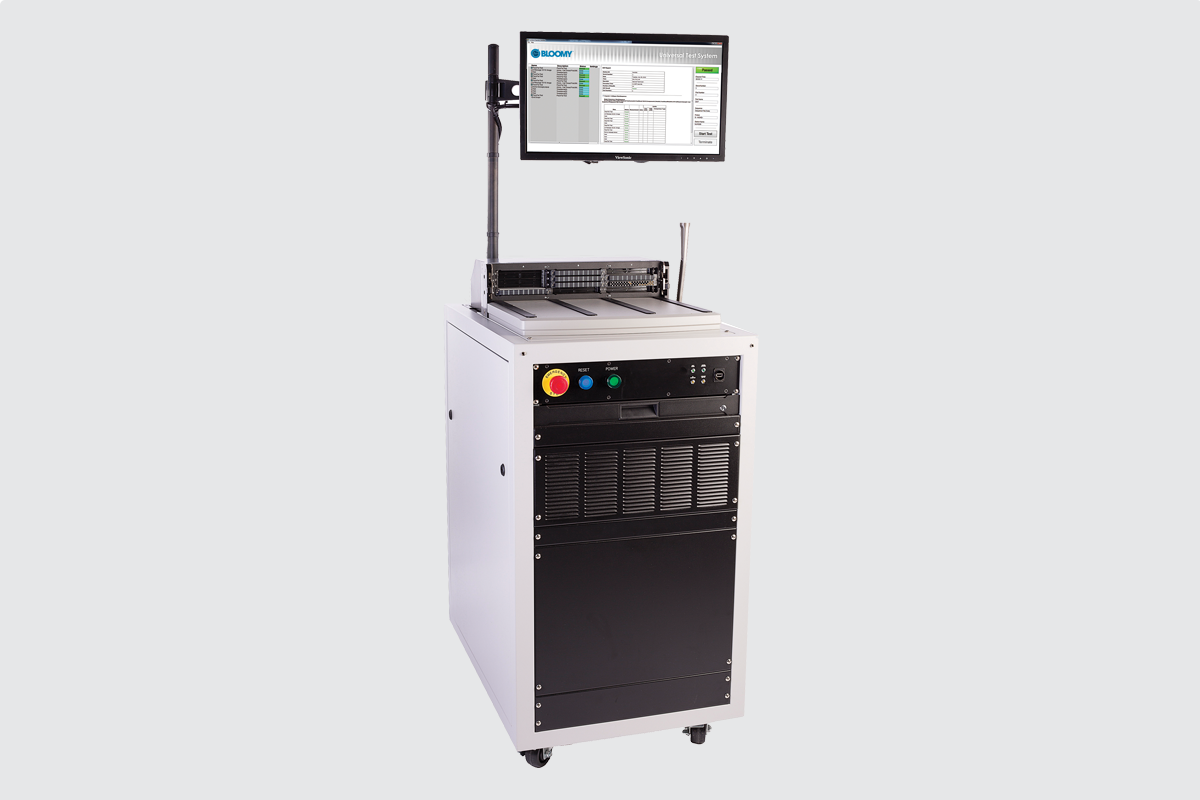
xUTS: Supports thousands of test points with advanced PXI signal routing, real-time HIL simulation, and modular mass-interconnect design for high-reliability, mission-critical applications. The xUTS offers greatly expanded I/O types and increased processing power to run real-time HIL simulations integrated into a production test system, enabling testing of UUTs in an operational state. It can support complex workflows, including real-time signal switching between simulated and actual subsystems, and can also be used as a high-volume, high-throughput tester. The xUTS has also been adapted to support depot-type operations where mixed UUTs are expected to be supported at low individual volumes.

UTS Comparison Table
| Feature | midUTS | UTS | xUTS |
|---|---|---|---|
| Controller | Fanless PC, Rack-mount PC, or Laptop | Rack-mount PC or PXI Controller | Rack-mount PC or PXI Controller |
| Instrument Platform | USB, Ethernet, LXI | PXI, rack and stack | PXI, rack and stack |
| Modular Instruments | DMM, Multi-function DAQ | DMM, FuncGen, Scope | Configurable |
| Power Supplies | Fixed: 5, 12, 24, -12VDC
2 Programmable DC: Configurable, 0-80V, 750W |
Up to 4 Programmable DC: -20V to 80V, 28A each | Customizable: Fixed and Programmable |
| Analog IO | Input: 16 SE, 8 Diff | Constrained by ITA implementation, optimized to support product mix / target takt time | Configurable |
| Digital IO | Input/Output: 24 (TTL) | Constrained by ITA implementation | Configurable |
| Communications | 2 ports: DB9 Serial Protocols | Configurable: RS-232, RS-422/485, CAN, SPI, I2C | Configurable: RS-232, RS-422/485, CAN, SPI, I2C, 1553, ARINC-429 |
| Switch Matrix/Mux | Up to: Six 64x4 1-wire matrix | Constrained by ITA implementation | Configurable PXI based Matrix and Multiplexers |
| ITA | Mass-interconnect cable VPC i1, 160 pin (2 - 4x) | Mass-interconnect panel VPC G12 or G12x | Mass-interconnect panel VPC G12, G12x, G18, or 9025 |
| Size | 12U (19" cabinet × 24"D) | 19U (19" cabinet × 32"D) | 40U (19" cabinet × 32"D) (1x–3x) |
Why Did BLOOMY Select Pickering Interfaces?
BLOOMY chose Pickering Interfaces for a shared commitment to flexibility, reliability, and scalability, all of which reduce NRE costs. Our modular approach to signal routing lets BLOOMY reconfigure UTS platforms as test requirements change, without extensive hardware redesigns.
Efficient crosspoint scaling is one key advantage. Pickering’s matrix-switching families share identical connector pinouts, and, because the pinout doesn't change, operators maintain a single set of manufacturing documents, allowing BLOOMY customers to expand I/O capability with minimal added NRE and no loss of compatibility or performance.
Pickering's hardware- and software-agnostic design is another deciding factor. Our switching systems integrate with a wide range of test equipment, while shared cabling and interconnect designs cut wiring complexity and simplify maintenance and upgrades. A consistent, software-agnostic API then lets engineers work across existing and custom solutions without retraining, so teams can focus on design rather than compatibility troubleshooting.
Together, these shared values and technical strengths position BLOOMY and Pickering as a strong partnership for delivering reliable, scalable testing solutions.
Our standardized hardware, such as PXI matrices and LXI chassis, ensures streamlined integration. This maintains durability and operational efficiency.
Results
Three real-world deployments demonstrate how the BLOOMY and Pickering approach reduces NRE costs and eliminates redundancy.
Scalable Test Architecture for a High-Complexity Defense Program
A leading defense contractor developing one of its most technically advanced products needed a test strategy that could keep pace with evolving requirements and future production volumes.
The customer initially deployed six UTS stations capable of testing 20 units in parallel, at an upfront NRE investment of over $500,000. As the design stabilized and full-rate production approached, throughput needed to quadruple. Building an entirely new system threatened to replicate the original engineering effort.
Instead, because BLOOMY designed the original testers for modularity and reusability, the new high-throughput test design cost only $50,000 in NRE, less than 10% of the original investment. The signal-based architecture and standardized interfaces enabled the reuse of existing test assets and code. The small-scale testers were redeployed to customer facilities for acceptance testing, running the same test codebase as the full-scale systems.
Outcome: A fourfold increase in production testing capacity with minimal additional engineering cost, and a future-proofed investment ready for additional product lines.
Unified Test Architecture for Production and Environmental Testing
A major electronics manufacturer needed to support production testing, ESS, and burn-in testing. Traditionally, these areas required separate systems with distinct hardware configurations and codebases, leading to duplicated engineering effort and code divergence whenever requirements changed.
By integrating Pickering switching hardware and the BLOOMY EFT Module for TestStand™ into their existing production ATE architecture, the customer extended a single platform and codebase to cover all three test environments. Updates to the production test code now propagate automatically across environments, keeping every system aligned.
Outcome: Dramatically reduced engineering time to deploy additional test assets, consistent test coverage across production and environmental testing, and a single scalable architecture serving multiple phases of the product lifecycle.
Scalable Core Test Platform for Multiple Product Variants
An electronics manufacturer needed to test a growing portfolio of related but distinct product variants. Historically, each variant meant a large investment in both hardware and software, with little reuse across systems.
The customer standardized on the BLOOMY midUTS as a core test platform, adapting to each variant by modifying only the interfacing fixture. By standardizing at the pin interface within the interconnect, fixtures always started from a defined template. Pickering's switching hardware routed signals as needed across products, and reusable software modules minimized custom code for each variant.
Outcome: New product variants deployed with minimal additional investment, reduced development cost and time-to-market, consistent test coverage across all products, and simpler system maintenance.
Conclusion
The partnership between BLOOMY and Pickering Interfaces reduces NRE costs by pairing Pickering's modular signal path hardware with BLOOMY's EFT Module for TestStand. Together, they enable flexible I/O configuration, modular system expansion, and efficient resource utilization across a wide range of functional test requirements. The UTS family of products addresses different UUT complexities and applications throughout a product's lifecycle, from burn-in through production and MRO, while reusing the same underlying test code across every platform.
This decoupling of hardware from test architecture keeps solutions scalable, maintainable, and cost-effective as test requirements grow more demanding. Teams gain a test strategy that adapts to new products and hardware without having to start from scratch, freeing engineers to focus on test development rather than architecture maintenance.
For additional technical details or integration guidance, contact us at Pickering or Bloomy Controls.


