
Comparing Tree and Conventional MUX Architectures
The two fundamental approaches to building a MUX are the Tree Architecture and the Conventional Architecture. Pole-switched MUXs share similar characteristics with conventional MUXs but leverage two-pole relays, often electromagnetic relays (EMRs), for improved functionality. Each construction method comes with its own set of advantages and limitations, offering unique benefits depending on the application.
Conventional MUX
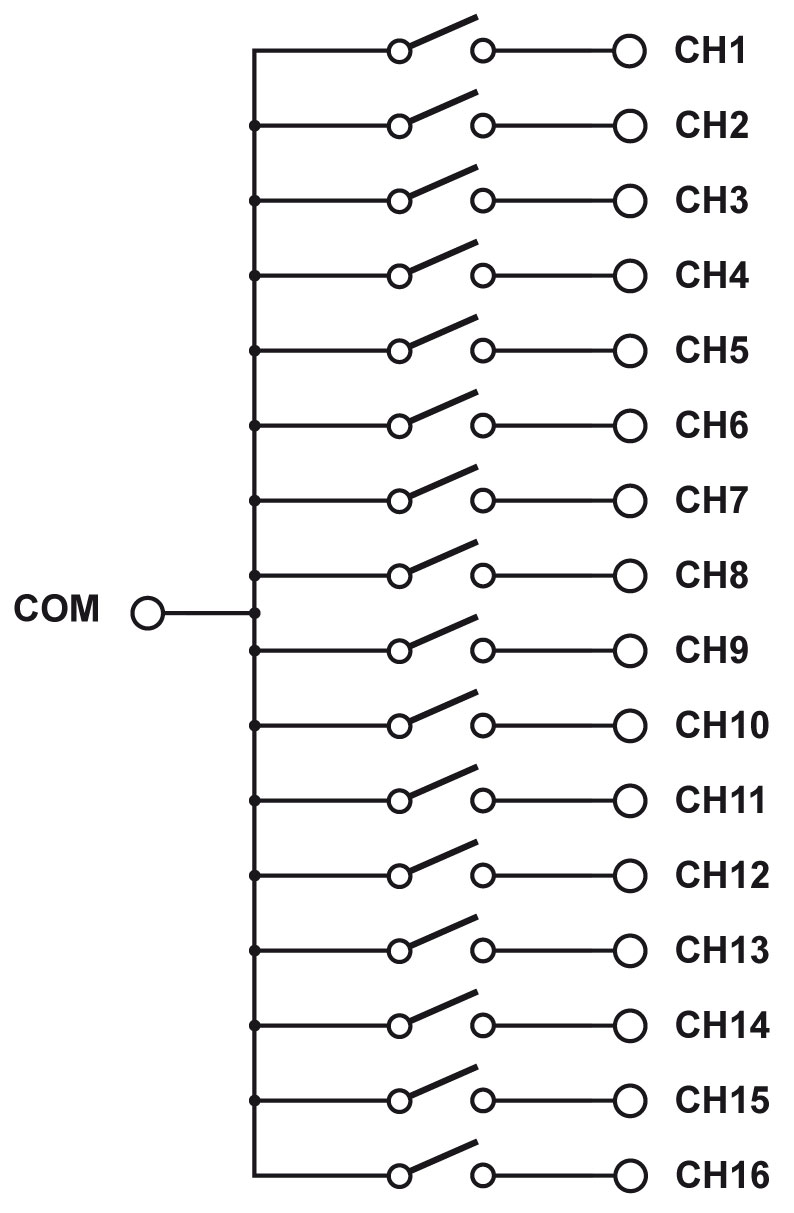
In a traditional MUX, a Common connection serves as the primary input (or output when the MUX is used for de-multiplexing) and is linked to multiple pathways via relays. Relay-based MUX systems can also function as de-multiplexers, allowing multiple signals to be routed to a single test port or enabling a single signal to be directed to one of many test ports.
The bandwidth (BW) of a multiplexer (MUX) is fundamentally constrained by the number of relays connected to the common node and the length of the tracks linking these relays. In designs utilizing mechanical relays, the primary limitation arises from tracking, which leads to capacitive loading. For solid-state designs, the relays themselves can become the bottleneck. Both issues contribute to excessive capacitance at the common node. Additionally, transmission line effects on longer connections can create a scenario where an open connection transforms into a short circuit at the common node at the quarter-wavelength frequency, resulting in significant insertion loss at those frequencies.
Aside from the bandwidth limitation, this approach is highly cost-effective and offers the lowest DC path resistance, as only a single relay needs to be closed to connect the signal. The architecture also supports the connection of multiple paths to the common point, depending on any limitations imposed by the driver. In software terms, we differentiate between two types of multiplexers (MUX): a standard MUX, which allows only one relay closure at a time, and a MUX M, which permits multiple relay closures simultaneously.
An isolation relay in the Common allows the MUX to link output connections together while keeping them disconnected from the Common, provided the driver supports this functionality.
Including an isolation relay in the Common makes the switch fully symmetric—all ports connect to an internal star point, and the distinction between the Common and a channel output becomes purely a matter of notation. Additionally, the isolation relay minimizes capacitive loading on external wire connections when the MUX is not in use.
To ensure a MUX executes a break-before-make operation, the driver must handle this process, requiring two distinct setting actions for the MUX.
One potential drawback of a traditional MUX arises if a relay becomes welded. In such cases, subsequent relay activations could inadvertently connect unintended parts within the test system, leading to undesired configurations.
Pole Switched MUX
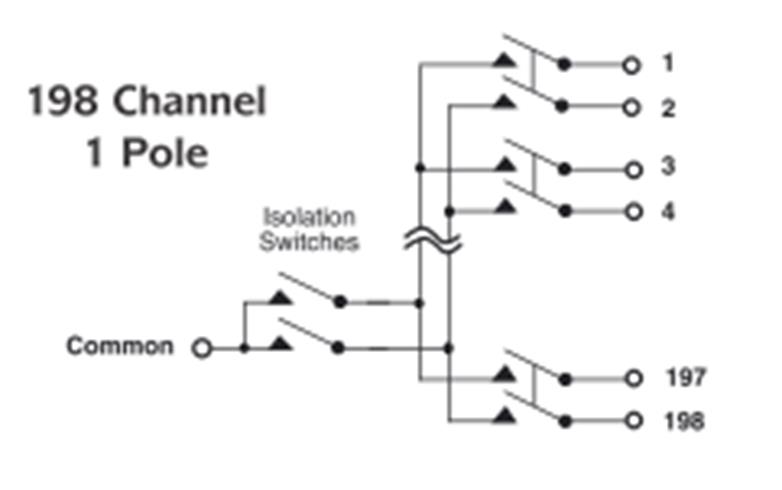
The Pole Switch MUX is a variation of the traditional multiplexer (MUX) that utilizes two-pole relays to expand its size beyond the minimum required.
In the example of a 198-channel MUX, 99 two-pole relays are used to provide 198 output connections. Two additional relays determine which pole is connected to the common output. This design requires fewer relays compared to using single-pole relays, making it a more efficient and cost-effective solution.
This approach is ideal for applications where users do not need multiple outputs to be connected simultaneously. The performance in terms of bandwidth and other factors remains comparable to that of a standard MUX, ensuring reliable functionality.
Tree MUX

A Tree MUX connects a common input to multiple outputs (or inputs) through SPDT relays. It employs a tree-like structure to expand the number of supported output connections. By using relays to determine which of two paths remains active, the MUX ensures that only one path is selected at a time. This design eliminates any risk of unintentionally linking output connections, maintaining clear and precise signal routing.
The path utilizes a series of relays, resulting in a higher DC resistance in the thru path compared to a conventional MUX. Additionally, Tree MUX designs require more relays than standard MUX configurations. Without the inclusion of extra relays, Tree MUXs inherently maintain a default connection between the common input and one of the outputs.
However, Tree MUXs offer a significant advantage in bandwidth (BW). This is because their paths are free from open circuit traces or additional relays that could create transmission line stubs. Consequently, they achieve the maximum possible bandwidth that the relays can deliver.
Tree MUXs are commonly utilized in RF matrices to deliver a wide RF bandwidth, as explained in our guide on Tree and Crosspoint Matrices. A key advantage of Tree MUXs is that no unnecessary tracks are connected to the RF path, minimizing excess capacitance and improving performance.
Another important application is in power systems, where the goal is to ensure that an input connects to only one output, even in the case of relay failure. Since Tree MUXs are built using changeover switches, a welded relay inherently blocks the creation of additional unintended paths, ensuring reliable and secure operation.
Summary
For low-frequency applications, a conventional MUX is the optimal choice, offering the lowest cost and superior performance in terms of path resistance. However, for bandwidth-critical applications that exceed the capabilities of a conventional MUX, or in scenarios where avoiding multiple closures (which could inadvertently connect outputs together) is crucial, a Tree MUX is the better solution.

