
Bringing USB to the PXI Test Environment
Much has been said about the integration of PXI products with LXI and VXI to create hybrid test systems, taking the best of each of those standards and combining them with the premier standard for modular instrumentation. We have certainly seen many synergies between PXI and LXI for switching applications, with LXI offering better solutions for large switching systems with higher performance and PXI offering better solutions for smaller and more diverse switching systems.
Very little has been said about combining PXI and USB products in a test system. Yet, USB is an extremely common interface for consumer and professional products and is ubiquitous on many mobile devices. That means that it may be a native control connection on a device that needs testing - so a test system ideally needs the capability of supporting USB.

The USB standard has enabled the development of elegant and cost-effective solutions for testing applications. For instance, USB-based RF power meters are offered by various vendors, alongside data acquisition systems, basic oscilloscopes, and digital multimeters (DMMs). These instruments often operate solely on USB power, eliminating the need for separate AC power sources. As a result, they are typically compact devices with modest power requirements, making them both efficient and portable.
They can also typically be placed more directly on a connection to be measured, for example a power meter sensor will be positioned at the RF connector, rather than be fixed in a chassis. USB devices can be positioned closer to the measurement point compared to chassis-mounted devices, provided they remain within a 5-meter range.USB devices offer unique features that can enhance a test system. Much like LXI, integrating USB alongside PXI components provides the benefit of increased flexibility and functionality within the system.
A USB device can easily be integrated into a test system via the USB ports on the system controller. When the system controller is external to the chassis, the USB devices operate independently and are not considered part of the chassis system. PXI embedded controllers often have a limited number of USB ports due to constrained panel space. This typically necessitates adding an external USB hub, along with an additional AC power connection to support it—an arrangement that isn’t always convenient.
When testing a device, it’s often unwise to connect it directly to an expensive PXI controller, whether embedded in the chassis or connected remotely. Test devices are, by nature, expected to have faults—otherwise, testing wouldn’t be necessary. Some of these faults could potentially damage the controller. Additionally, introducing a faulty device into a system can lead to unexpected issues, such as causing the controller to freeze or malfunction.
USB technology, while widely used, occasionally faces reliability issues, such as failing to establish a proper connection with the controller. In manual systems, this is a minor inconvenience—users can typically resolve it by unplugging and reconnecting the device. However, in automated test systems, where minimal manual intervention is key to maintaining efficiency and throughput, such disruptions pose a greater challenge.
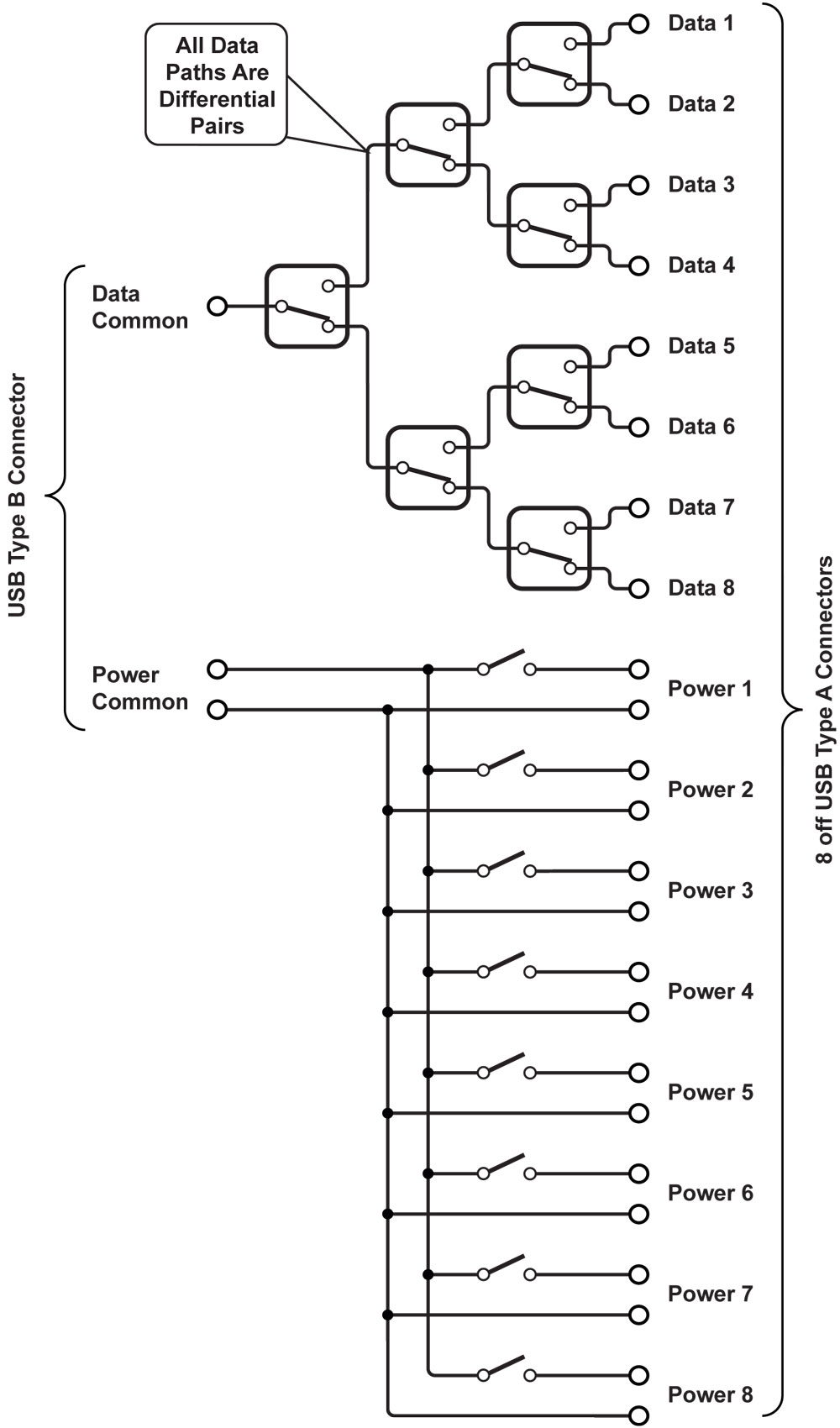
We offer PXI-based solutions for USB switching which features a USB switch (model 40-737A) capable of connecting a single USB input to one of eight USB devices. This enables a test system to seamlessly and programmatically select any of the connected devices to interface with the common USB connection, all through our standard switch driver.
However, it does not support simultaneous connection to all USB outputs—a USB hub is required for that. Instead, it provides a way to connect a single USB "common" to one of eight USB output connections using a mechanical relay-based switch. Our USB hub (model 40-738A) addresses this limitation, offering seamless integration of USB test devices and equipment directly into a PXI chassis, simplifying the process and enhancing connectivity.
40-738 USB Hub
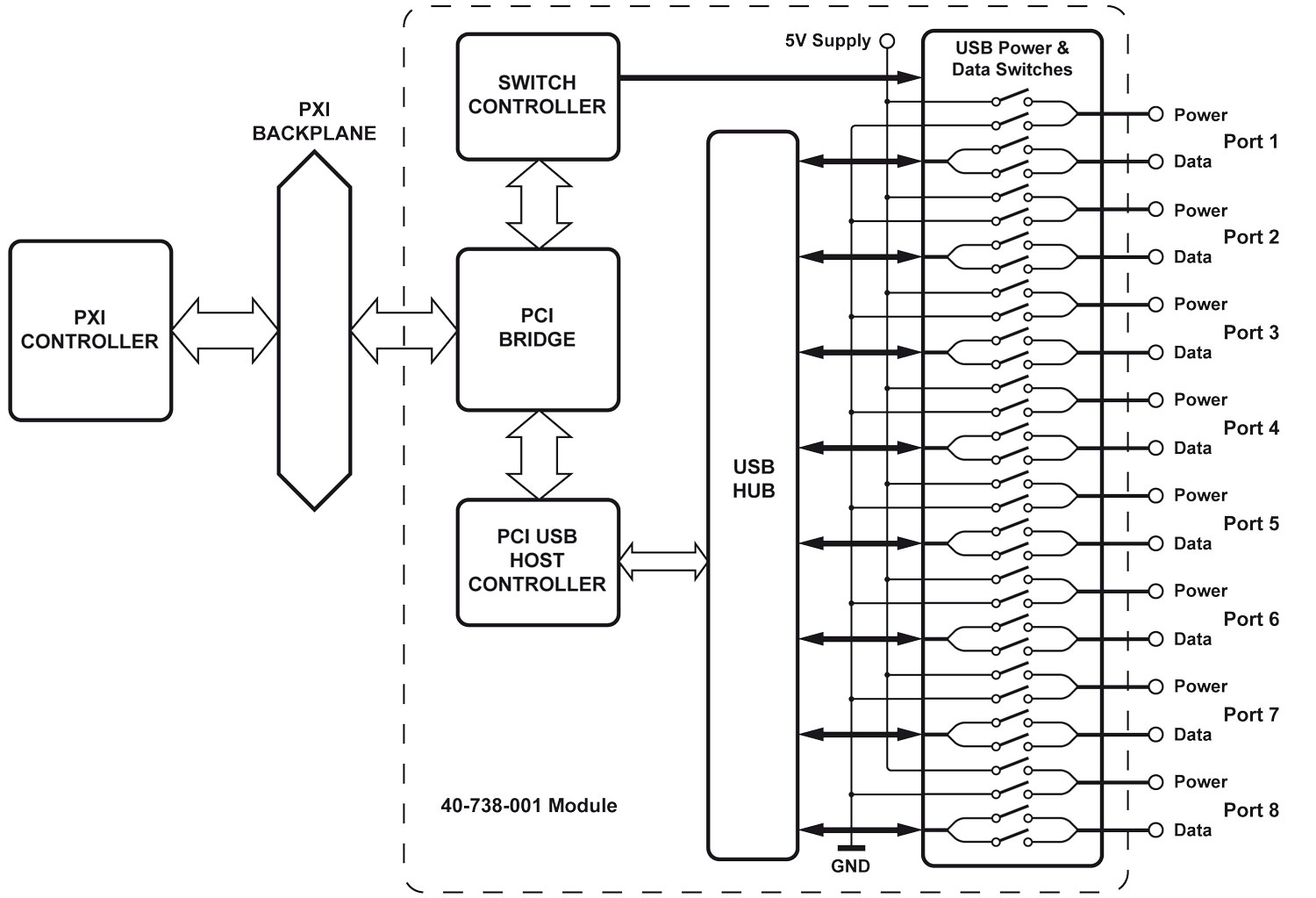
The 40-738 USB hub allows a USB connection to one or more USB outputs to be made from the PCI bus of the PXI system controller
 The USB hub is a compact, single-slot 3U PXI module designed to enhance connectivity and control. It features an 8-port
USB 2.0 hub paired with USB data and power switching, enabling seamless management of connections between the PXI controller's
PCI interface (via the PXI backplane) and USB devices. Unlike the 40-737, the 40-738 interfaces directly with the PCI
backplane of the PXI chassis instead of relying on a USB connection to the controller. It connects to the controller’s
internal PCI bus via the chassis PCI bus, just like other PXI modules. While the hub is recognized on the controller's
device list as a standard USB hub, the 40-738 is seamlessly integrated into the PXI chassis for streamlined functionality.
When USB products are connected to the 40-738, the driver installation process is identical to that of any standard USB device. The PXI controller, whether remote or embedded, automatically detects the USB device and installs the manufacturer's drivers, as if the device were connected directly to the controller’s native USB ports. This seamless process is familiar to all PC users and requires no additional software support from our end.
The 40-738 delivers enhanced control capabilities, enabling independent connection or disconnection of USB data and power lines. This functionality allows users to simulate fault conditions on the USB interface or fully disconnect a USB device, replicating the effect of physically unplugging the connector. All of this can be managed programmatically through our PXI switch drivers, offering precision and convenience.
The 40-738 not only offers a programmatically managed USB connection but also eliminates the need for standalone powered hubs within a system. By integrating USB connectivity directly into the chassis, it removes the reliance on separate USB hubs, streamlining the setup. Additionally, this design ensures that any connected USB device is properly released from the physical port at the moment of disconnection, enhancing reliability and ease of use.
Summary
The USB hub not only facilitates the testing of USB products but also enables the seamless integration of USB instrumentation into PXI systems. This includes devices such as power meters, oscilloscopes, and data acquisition tools, broadening the range of test solutions available. In some cases, it introduces new capabilities like power measurement, while in others, it allows for the integration of cost-effective USB data acquisition devices directly into the PXI chassis, bypassing the controller.
By streamlining the incorporation of USB devices and test equipment into the PXI environment, the USB hub module significantly enhances flexibility and expands options for users of PXI test solutions.


Other useful links:

