

Testing is vital to product development and manufacturing, ensuring high-quality units for competitive markets. But depending on the product being tested, your test system budget for new products may be limited. The prospect of high product liability may demand more thorough testing requirements, while other products with a small profit margin or simple fault tree possibilities could mean that accounting will make some downward projections on what test engineering can spend.
Budget constraints often challenge engineers tasked with expanding or updating existing systems to meet changing market demands and throughput goals. By leveraging modular test system architectures, it is possible to expand functionality effectively without excessive costs. This article explores the strategies for modifying and extending modular test systems, specifically focusing on reuse, efficient system design, and making informed resource decisions. The assumption is that your present test system was built on a popular modular system strategy, and the PXI standard is used here. In any case, many of the suggestions here can still be applied.
Strategies for Test System Expansion
The process of expanding an existing modular test system should begin with a detailed analysis of its current and future capabilities and DUT (Device Under Test) requirements.
1. System Tactic Requirements
When re-purposing a test system, it is essential to understand what the redesign is supporting in terms of products and volumes. Let’s look at a couple of possibilities.
- Expanding Supported Applications – This is a situation where the test system will be used for many different products in its day-to-day operations. This strategy is ideal for low-volume, high-mix test requirements. Typically, this could be a field repair depot (especially in Mil/Aero applications) or a rework tester at the end of a production line. In these instances, chances are that the system will be testing product(s) it was initially designed for as well as additional test requirements. The challenge in expansion is keeping all the original test hardware and adding new hardware where necessary. Usually, it is desirable to keep the tester footprint as close to the original as possible.
- Re-purposing Test Systems for New Applications – In this case, test engineering is re-purposing a test system for a new product requirement. This would be typical in a low-mix, high-volume test strategy. The goal is to reuse as much of the original test system as possible and add what is necessary to address the new product. Modular chassis, power supplies, simulation, switching, and general-purpose instrumentation are what come to mind initially. However, other test hardware may be reused if the new product has specifications similar to those of the previous product. Again, the test system footprint may be critical. I remember a production manager once told me that bigger test systems required more “Concrete”! By that, the manager meant that additional production floor space may be necessary, especially if the expansion affects many test systems. This may sound silly, but it should be considered when developing test systems.
2. Evaluate System Requirements
Expansion often involves testing additional devices under test (DUTs) or adapting to new test specifications. Begin by identifying:
- The parameters and accuracies to be measured or simulated.
- The constraints of the current system, such as channel limitations or bandwidth capacities.
- Throughput – What is the expected test time for the new products compared to the previous products being tested? What is needed to address the speed issue?
- "Pallet Testing," which involves testing multiple DUTs simultaneously, may necessitate increased signal switching, along with additional power supplies and instrumentation.
- Test fixturing should be robust and easily used to minimize the system down time.
- If test times are critical, removing test steps is often considered. However, this can be a big problem if a critical parameter is not exercised. So, be very careful with this tactic.
- The compatibility of existing PXI/PXIe modules with new specifications.
- Available modular chassis slots for expansion
- Instrumentation data bandwidth and additional chassis—In the case of PXIe chassis, will the expansion test plan work well with lower-cost Gen 2 chassis, or is a more expensive Gen 3 a requirement now and/or in the future?
- Another factor to consider is whether only a few additional slots—perhaps up to six—will be sufficient to meet foreseeable needs.
- If so, we offer solutions that will fill this application at a low cost and save considerable rack space. More on that later.
Consider chassis selection where adequate PXIe hybrid slots can accommodate both PXI and PXIe module types, enhancing backwards compatibility and adaptability. If additional slots are required, verify the availability of open slots in the existing chassis or explore solutions like adding smaller chassis to the system.
3. Optimize the Use of Existing Resources
Rather than replacing the complete system, re-purpose general-purpose modules, if possible, for example:
- Source instrumentation, such as analog and digital outputs, waveform generation, etc., and measurement instrumentation, such as digital multimeters (DMMs), data acquisition, digitizers, digital inputs, etc., are suitable for a range of common functional production tests. Switching can be used as necessary to expand the instruments’ access to the DUT.
- If possible, use existing redundant instrumentation creatively for new applications to avoid purchasing new equipment. An example is leveraging digital I/O with programmable input voltage thresholds as an alternative to a DMM for parallel DC measurements in specific applications.
- Power Supplies: Frequently compatible across multiple DUTs.
- Switching: Switch modules (general purpose, multiplexer, and matrix) can often be repurposed, but check compatibility with required voltage, current, power, and frequency switching requirements.
- Chassis Extensions: Populate unused slots to increase capacity before investing in additional chassis hardware.
- Connectivity: Existing instrumentation, switching, and test interfaces (e.g., mass interconnect receivers) will usually require new cabling to make the required interconnections to the DUT. Custom cables can be quickly and easily graphically designed using our free online Cable Design Tool.

Figure 1: PXI test system expanded with an additional LXI chassis with Pickering modules.
4. Expand Modularly with Cost-Effective Solutions
When expansion requires additional hardware:
- Add additional PXI/PXIe Chassis: It is possible to daisy-chain up to three PXI/PXIe chassis for enhanced functionality. Note that our 8-slot and 18-slot PXIe hybrid chassis—along with other vendors’ high-performance chassis—support high-speed Gen 3 PCIe architectures with bandwidths of up to 24 GB/s, capable of supporting very high data rate instrumentation. However, care must be taken so that the chassis link hardware used is able to support Gen 3. For applications that don’t require this level of performance, a Gen 2 PXIe Hybrid chassis such as our 18-slot or 21-slot is the most cost-effective route.
- Add proprietary LXI/USB modular chassis: These chassis can house our PXI switching, simulation and instrumentation modules. They are more cost-effective alternatives to standard PXI chassis, and are simply connected to the system controller’s Ethernet or USB port. Our LXI/USB chassis are available in space-saving 2-slot, 4-slot, and 6-slot versions, as well as standard 4U 7-slot and 18-slot variants, and the control simplicity allows them to be optimally sited in the test system.
- As several of our LXI/USB chassis have a small footprint, it is possible to move critical switching closer to the DUT. This has a potential advantage, as the cables can be shorter, resulting in lower insertion loss and capacitance, which can improve measurement quality.
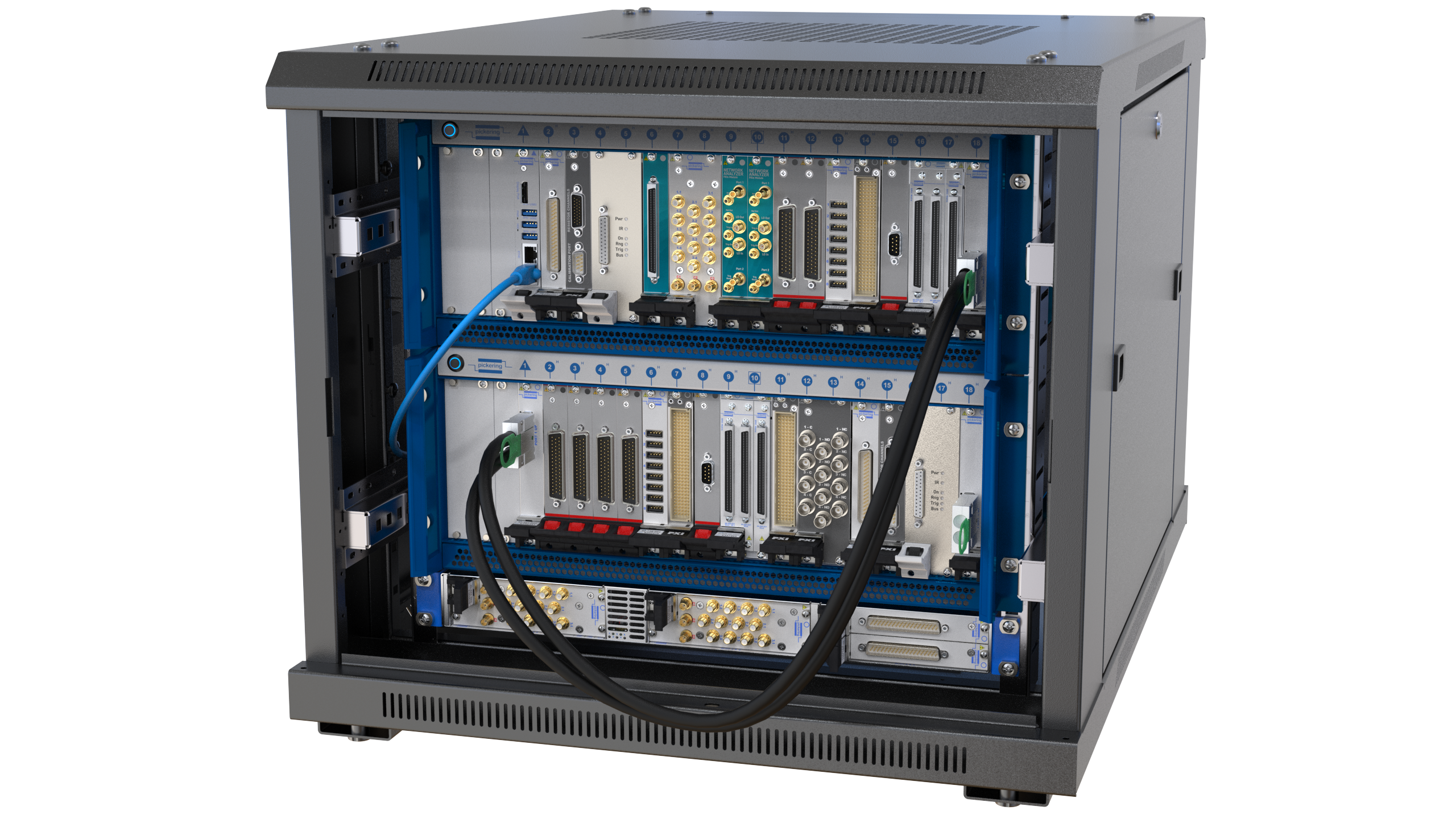
Figure 2: Shows a system using an embedded controller: Two peripheral-slot daisy-chained PXIe chassis with an additional 1U 6-slot LXI chassis connected to controller via Ethernet
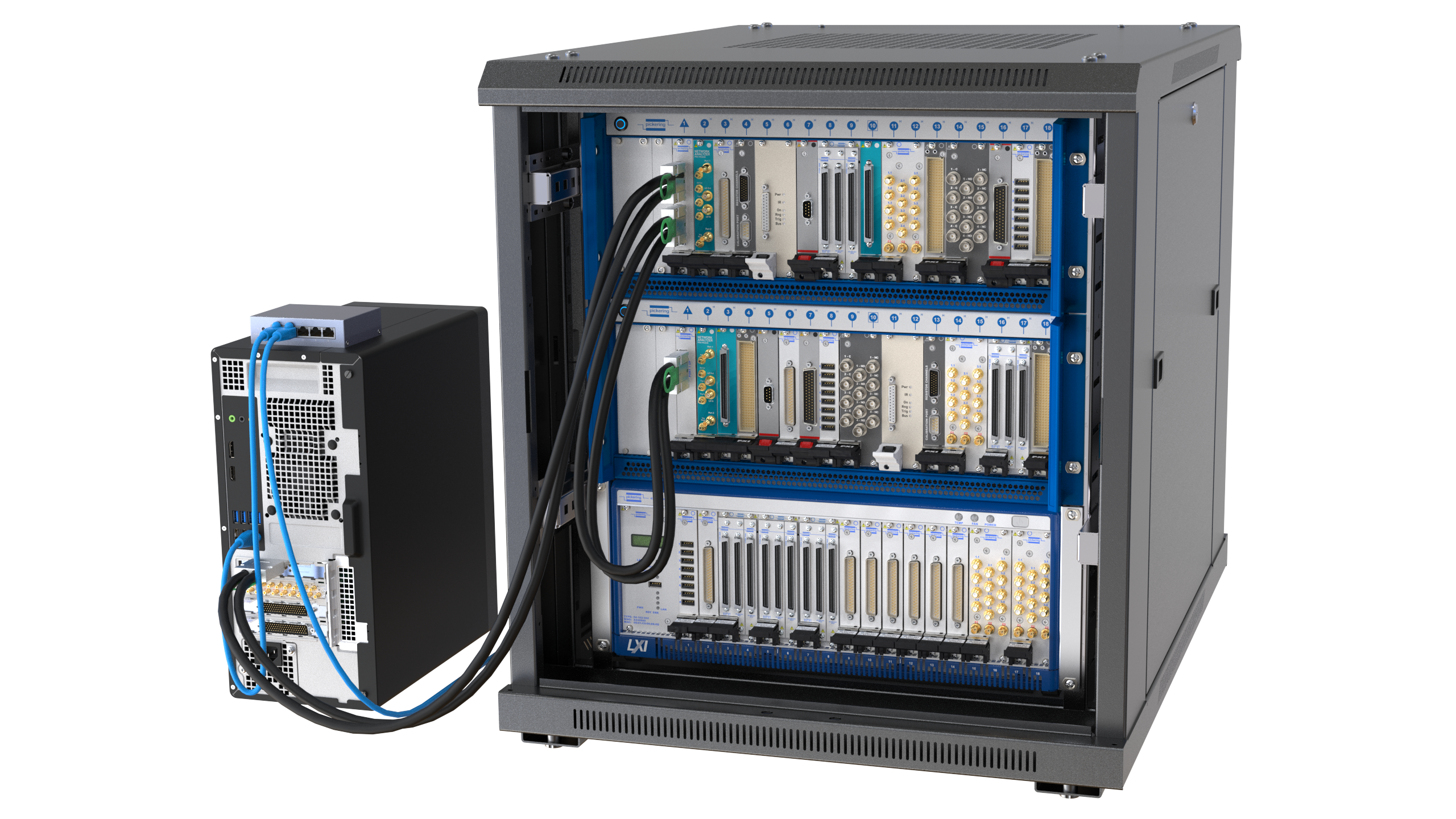
Figure 3: shows a system using an external PC controller: Two controller-slot daisy-chained PXIe chassis with additional PC-controlled 18-slot LXI chassis and integral PCI cards
This PXI/PXIe chassis versus LXI/USB chassis decision must consider the module selection, the additional performance and power requirements, and the available test system space.
Matching new modules to your existing architecture is pivotal for successful expansion. Use these recommendations:
- Review Open Standards: Ensure all modular devices selected comply with industry standards for compatibility. Failure to do so may require a different modular standard chassis to be specified, which may incur added costs and possible compatibility issues. Note that in Figure 3, you will see several PCI modules fitted into the external PC controller. This is the lowest-cost way to add simple functionality (e.g., we supply PCI switching, programmable resistors, and Digital I/O cards) to a test system, provided that the PCI or PCIe cards are compatible with the spare slots in the host PC. PCI slots are more prevalent in rack mount PCs. 3 PCIe switch fabrics, but otherwise, opt for a more cost-effective Gen 2 chassis
- Assess Bandwidth Needs for Now and in the Future: High-performance tests may require advanced Gen.
- Cooling and Power Design: High-density systems with multiple hybrid slots may demand high power capability and innovative cooling solutions, such as those in our 21-slot PXIe hybrid chassis. This features dual 900W modular power supplies and per-slot cooling of up to 100W. Also, some PXIe instruments use so much power that they may not operate at peak efficiency in some PXIe chassis.
6. Setting Realistic Expectations for System Expansion
Before purchasing, answers to these crucial questions will prepare your expansion plan:
- What additional hardware do you need, and is it fully compatible with the existing test system?
- Does the existing test system chassis have adequate rack space?
- Does the existing test system have adequate cooling capacity for the added test hardware? If not, how easy is it to add more cooling?
- If using a mass interconnect system, does the receiver have adequate slots? In other words, if additional instruments and the prerequisite cabling are needed, is there adequate expansion capacity, or is a new mass interconnect necessary? In the test strategy, where the expanded test system has to support earlier DUTs, as well as new products, compatibility of test fixturing should be the first question to ask your mass interconnect vendor.
- Can the controller manage additional communication without impacting test speed?
- Are there creative ways to meet test requirements without new purchases?

Figure 4: Shows the Curtis Instruments' second generation test system with expansion capabilities
7. Emerging Trends in Modular Test Systems
Industry trends indicate growing support for high-bandwidth PXIe Gen 3 solutions, with data rates exceeding 24 GB/s per system. Additionally, hybrid slots that can seamlessly integrate both PXI and PXIe modules are increasingly valued for their adaptability.
Adopting designs with integrated Ethernet or USB-C connectivity, like our LXI/USB chassis, further minimizes system footprint and cost while simplifying system integration.

