
General Purpose PXI Relay Switch Modules
General-purpose PXI relay switch modules are switching cards that control electrical signals within a PXI test system using independent relays. They allow the test system to programmatically connect, disconnect, and route signals between instruments and the device under test (DUT) without manual rewiring. Pickering Interfaces offers a wide range of general-purpose PXI relay switch modules for automated test systems. Each module consists of multiple independent relays in single-pole single-throw (SPST), single-pole double-throw (SPDT), double-pole single-throw (DPST), or double-pole double-throw (DPDT) configurations.
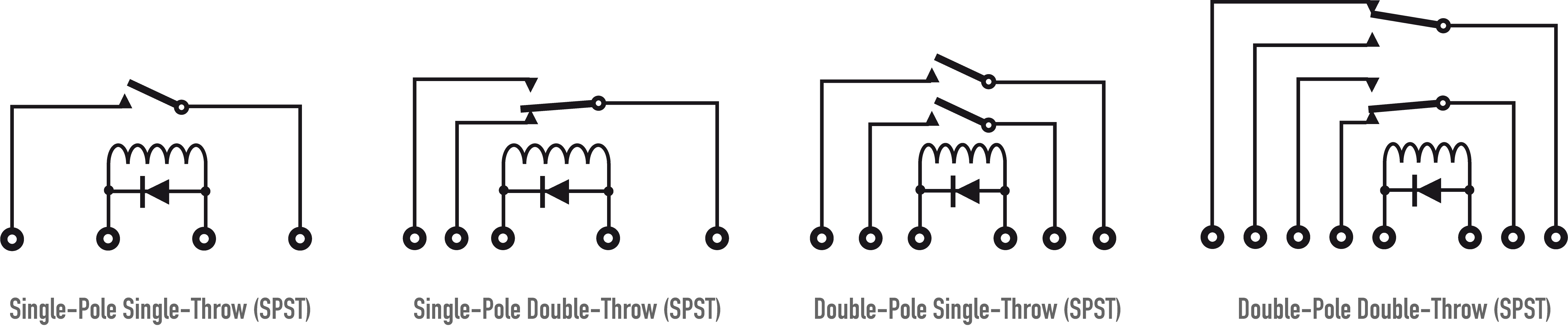
With relay types spanning Pickering instrumentation-grade reed relays, electromechanical relays (EMR), and solid-state relays, you can select the switching performance that matches your application, from low-density, small-signal routing to high-power up to 40A and high voltage up to 7 kV.
What Is a General-Purpose PXI Relay Switch Module?
General-purpose PXI and PXIe relay switch modules are plug-in cards that provide banks of uncommitted relays for signal control and routing in a compatible chassis. "Uncommitted" means the relays aren't pre-wired into a fixed topology, so you can connect them to build the exact switching scheme your application requires.
At a basic level, each relay acts as a software-controlled switch. Your test program sends a command through the module's driver, the relay opens or closes, and the signal path changes accordingly. You'd typically use a general-purpose relay module when your application calls for straightforward on/off signal control rather than a structured matrix or multiplexer. Common uses include connecting instruments to different DUT pins, isolating circuits during test, and simulating switch contacts in PXI test systems.
Quick Selection Guide
| Module Type | Relay Count | Configurations | Key Rating |
|---|---|---|---|
| Low Density Reed Relay | Up to 32 | SPST, SPDT, DPST | Fast, long-life, low-power switching |
| High Density Relay | Up to 100 | SPST, SPDT, DPST | Maximum switch density per slot |
| Medium Power Relay | Up to 83 | SPST, SPDT, DPST, DPDT | Up to 2.5A current handling |
| High Power Relay | Up to 50 | SPST, SPDT, DPST, DPDT, SP4T | Up to 40A current handling |
| High Voltage Relay | Up to 24 | SPST | Up to 7,000VDC |
Software and Connectivity
Pickering provides online graphical design toolsets, software drivers, soft front panels, example programs, and development support for seamlessly integrating our PXI relay switches into automated test systems. Drivers are available for Windows, Linux, and real-time environments. Our products can be integrated with all popular test, automation, and software-development environments, including LabVIEW, C++, .NET, and Python.
Explore our Software and Drivers
For complex switch systems, our Switch Path Manager signal routing software automatically determines and manages signal paths, simplifying programming and maintenance of large switching configurations. To speed up integration, we also offer a wide range of in-house-manufactured standard and custom mating cables and connectors.
Our PXI modules can be installed in any compliant PXI chassis or Hybrid slot in a PXIe chassis, and you can also host them in our LXI/USB modular chassis for remote control over Ethernet or USB. Our PXIe modules may be used in any compliant PXIe chassis.
eBIRST diagnostic tools are available for all our PXI/PXIe relay modules up to 2A current handling. These simplify system maintenance by automatically testing supported products, graphically identifying faulty relays, minimizing system downtime, and maintaining confidence in the integrity of the signal path.
Frequently Asked Questions
What's the difference between reed relays and electromechanical relays?
Can I use PXI relay switch modules in a PXIe chassis?
How do I control which relays open and close?
Which module should I choose for high-current switching?
Find Your Switching Solution
Not sure which module fits your application? Use our Product Selector to filter by relay type, configuration, and rating, or design your complete signal path with our Test System Architect (TSA) toolset.


