
PXI Chassis and Remote Controllers
The PXI standard specifies two different module control formats: PXI, based on the parallel PCI bus, and PXI Express (PXIe), based on the newer, higher-speed serial PCI Express (PCIe) bus. Each format requires a specific chassis backplane design incorporating dedicated PXI or PXIe module mating connectors. In addition, PXIe chassis are available with special Hybrid slots that combine PXI and PXIe connectors and accept either module format.
Pickering’s PXI and PXIe remote-control solutions interface to Pickering’s or any other vendor’s compliant chassis and allow them to be controlled from a remote desktop, rackmount, or server PC via a software-transparent cable connection. They also allow multiple chassis to be interconnected and controlled by a single controller in a daisy-chain or star configuration.
What Are PXI Chassis and Remote Controllers?
A PXI chassis is the mechanical and electrical foundation of a PXI test system. It houses the required PXI instrumentation/simulation/switching modules, supplies DC power to each slot, cools installed modules with forced air, and carries the PCI or PCIe backplane along with PXI-specific timing, triggering, and synchronization buses. Every chassis requires a dedicated controller to communicate with its installed modules, and this can be either “embedded” or “remote”. An embedded controller is basically a specialized PC in PXI module format that occupies the chassis’ dedicated controller slot and optionally the adjacent mechanical expansion slots for a multi-slot version. A remote controller, by contrast, consists of a PCIe interface card installed in an external PC that connects to a matching controller module in the chassis' system slot, allowing that PC to control the chassis as if the installed modules were its own internal boards.
Engineers typically choose this pairing when they need to drive a PXI chassis from a standard desktop, workstation, or server rather than committing to a specialized embedded, in-chassis controller. This is a common requirement in defense and automotive test cells, where system racks run alongside existing lab PCs and need to integrate without disrupting established software environments.
How Does a PXI Chassis Work with a Remote Controller?
Power on the chassis before the connected remote controller PC. On bootup, the PC's BIOS enumerates the PXI or PXIe chassis as an extension of its own PCIe bus, identifying each installed module and assigning it a bus and device number. From that point, the modules behave exactly as if they were cards plugged directly into the host computer, with no difference in driver-level operation between local and remote control.
With comprehensive hardware and software transparency, our expansion kits enable fast, convenient detection and control of any PXI cards installed in the system, without requiring additional drivers or software.
PXIe Chassis Remote Control Kit: The 43-921 expansion kit allows control of PXIe modules installed in a PXIe chassis (and both PXIe and PXI modules in a Hybrid PXIe chassis), providing up to 4 GB/s system bandwidth using PCIe Gen 2 x8 signaling. The kit consists of a 53-921-001 PCIe adapter card installed in the host, a PCIe x8 cable up to 5m long, and a 43-921-00x PXIe interface module for insertion into Slot 1 of a PXIe chassis.
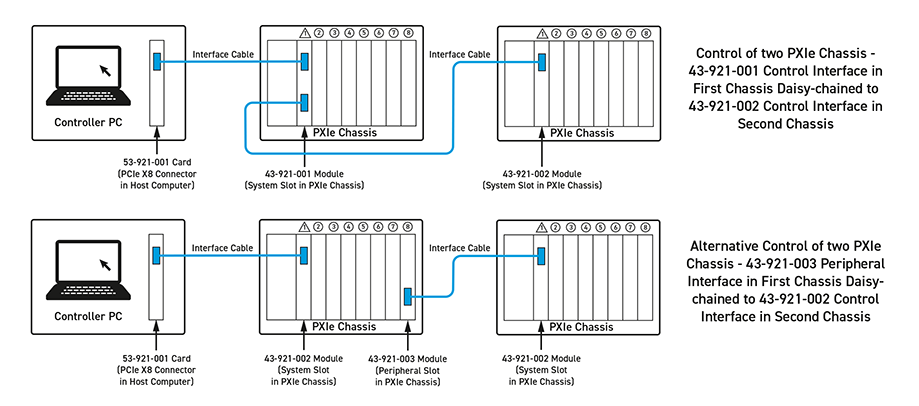
Multiple PXIe Chassis Control: You can achieve control over multiple PXIe chassis with our PXIe Remote Control Interface Module with Daisy-chain Facility (43-921-001), which has dual ports that support multi-chassis control in a daisy-chain configuration. The upper port is connected to a PCIe Remote Control Interface Card (53-921-001) installed in a host PC, and the lower port is connected to a PXIe Remote Control Interface Module (43-921-002) in the system slot of a second chassis. Alternatively, a 43-921-003 module fitted to a peripheral slot in the first chassis can be used to control a 43-921-002 module in the second chassis - see diagrams below.
PXI Chassis Remote Control Kit: Our PXI Chassis Remote Control Kit (41-924-001 KIT) is supplied with a PCIe card that can plug into any PC’s PCIe slot, a PXI module for insertion into Slot 1 of a PXI chassis, and a high-speed cable up to 7m long to connect the two together. The interface uses a single-lane PCIe connection from the PC to provide a software-transparent link between the PCIe and PXI backplanes. The supplied shielded cable ensures robust system operation and adequate separation between the PC and the PXI chassis.
When Does a Test Engineer Need a Chassis and Remote Controller Combination?
- An existing lab PC or server already provides the computing resources a test system needs.
- Cost and availability constraints rule out an embedded controller.
- Multiple chassis must be managed from a single host, whether daisy-chained or run in parallel.
- Technicians prefer a familiar desktop operating environment over an embedded PC's front panel.
If none of these apply, an embedded controller (covered in detail on the PXI & PXIe Controllers page) may be the simpler route.
Choosing Between Chassis and Controller Options
Use the checklist below to narrow your selection:
| Requirement | Recommended Direction |
|---|---|
| Need the system to run without an external PC | Embedded controller |
| Want to control from an existing desktop or vServer PC | Remote controller with matching interface kit |
| Testing in a noise-sensitive lab environment | Chassis with acoustic noise reduction |
| Controlling more than one chassis from a single host | Daisy-chained or parallel remote-control configuration |
| Mixing PXI and PXIe modules in one system | Hybrid-slot PXIe chassis |
Compatibility and Connectivity
Every PXI and PXIe chassis in our range accepts compatible modules from any PXI Systems Alliance member, so an existing module inventory carries forward without redesign. Our LXI/USB modular chassisaccept any of our PXI modules and offer an alternative where Ethernet or USB3 control, driverless operation, or isolation from a Windows-based controller PC is preferred.
Find the Right Chassis and Controller for Your System
Use the Product Selector to filter chassis and controller options by slot count, bus type, and control method, or build out the full signal path with the Test System Architect toolset. For system-specific guidance, including compatibility questions across multi-vendor test racks, contact our applications engineering team directly.
Chassis Solutions Brochure - Overview of our flexible & scalable PXI, PXIe, LXI, LXI/USB Chassis


