

Pickering's HIL System Expertise: Collaboration & Modularity
At Pickering, our strengths reside in modular switching, sensor simulation, instrumentation, and connectivity solutions. However, we also collaborate directly with system integrators and customers’ engineering teams to design, develop, and sustain complete modular hardware-in-the-loop (HIL) simulation systems. To accomplish these goals, we leverage our in-house expertise and a combination of industry-standard platforms to offer durable and effective COTS hardware and software solutions.
The Advantages of Pickering HIL Systems Include:
Longevity and Reliability
- Over 55 years of electronics design and manufacturing experience.
- We still support products more than 25 years after their introduction.
- Our products are supported globally by an extensive network of direct offices and distribution/system integration partners .
- Modular architectures facilitate maintenance and obsolescence management
Modularity
- A wide choice of switching, simulation, instrumentation, and connectivity products provides application-optimized, high-performance HIL solutions.
- Plug-and-play compatibility simplifies system design and integration
- Flexibility for ongoing system functionality upgrades
- Scalability for larger applications and parallel testing
- Reduced cost and space – purchase just what is currently needed with easy future expansion
Open S/W Environment
- With support for all major HIL software platforms
- NI software such as VeriStand (CustomDevices), TestStand, LabVIEW, etc.
- Mathworks’ SimuLink and MatLab
- Vector CANoe (CAPL)
- All popular programming languages such as C, C++, Python, .NET, etc.
- All popular real-time operating systems, such as NI Linux Real-Time, PharLab, QNX, Windows, RTX, and other major Linux distributions
Components of a Modular HIL System
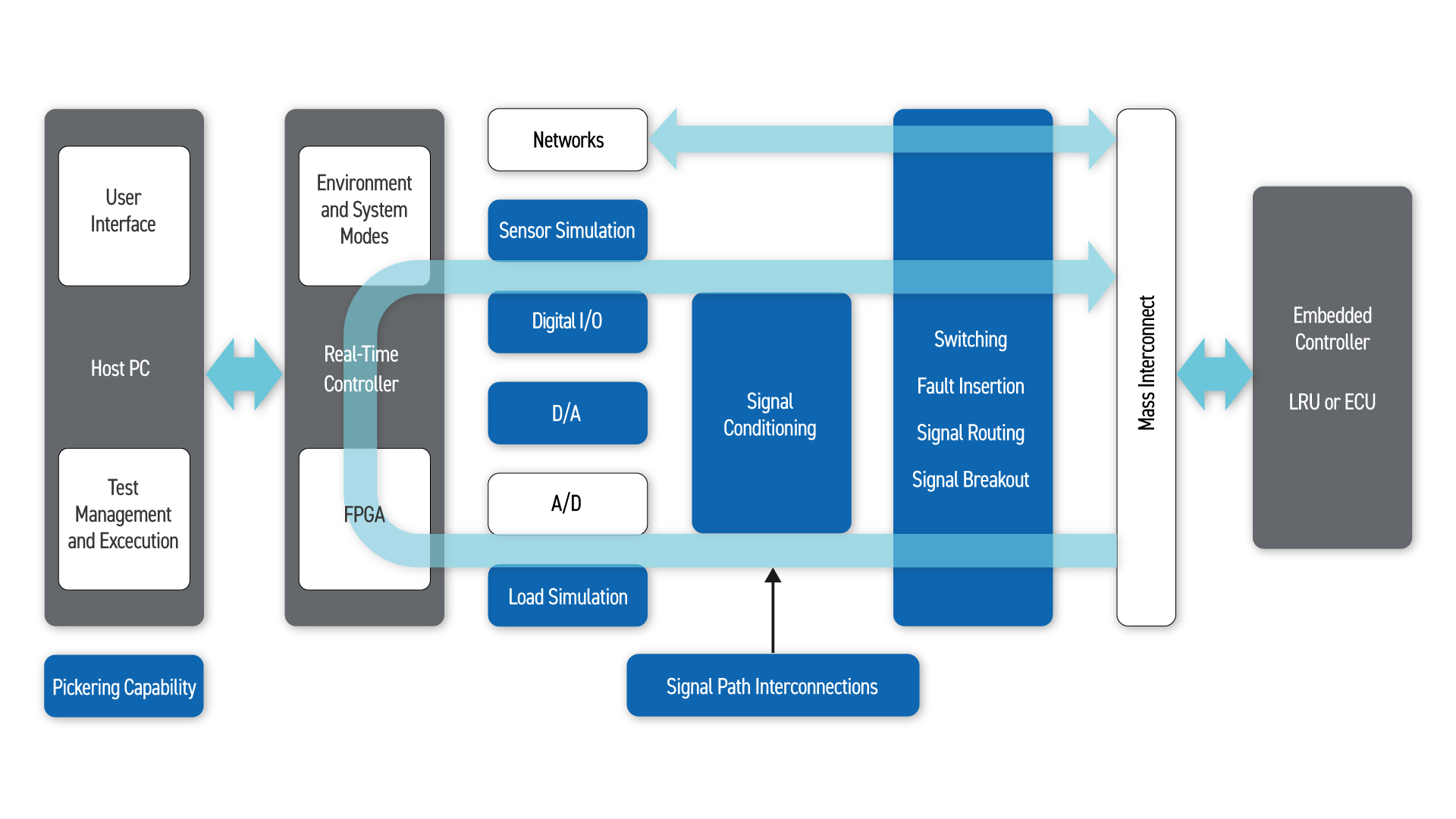
HIL simulation integrates hardware components with simulated inputs and outputs—including real-time processors, signal conditioning equipment, and software—to create a closed-loop system that replicates real-world conditions. It is especially useful for validating the operation of embedded controllers under environmental conditions that are too dangerous to apply physically to the units under test.
Hardware-in-the-Loop Applications

Fault Insertion Test
Fault Insertion test is a method that intentionally introduces errors to verify the system's fault tolerance and recovery mechanisms. Fault insertion units (FIUs) are especially needed in safety-critical applications like automotive braking systems, aerospace flight control systems, and power grid management. By intentionally introducing faults, engineers can observe how the system responds, identify weak points, and ensure the system can recover and that safety mechanisms are working correctly.
Products
- PXI Fault Insertion Switching (Fault Injection)
- PCI Fault Insertion Switch Cards
- Modular Breakout System (MBOS) for HIL Simulation
Related Content


Related Content
Sensor, Battery, and Load Simulation
Sensor simulation is used to verify the interactions between sensors, actuators, and the control system, such as an ECU. It is particularly useful in applications like electronic stability control and adaptive cruise control for automotive and autonomous vehicle systems and flight control systems for aerospace. These modules are also useful in robotic arms and conveyor systems for industrial automation and many other industries, such as energy, communications, space/satellite, EVs, etc.
Simulation Products |
Instrumentation Products |
High-Performance Switching & Interconnection
Ensuring your HIL system’s signal integrity is essential. With our relay and connect divisions in our umbrella of companies, we can offer the quality and control benefits of high-performance reed relays and cabling in-house by maintaining measurement accuracy, reliability, low loss, and consistency. We can also tailor custom-designed switching and cables to your application to ensure the highest integrity and offer online tools to make the cable design process seamless.
Products:
- PXI Switching Modules
- LXI Switching Modules
- Custom Cabling with the Cable Design Tool
- Standard Cables & Connectors
Related Content
Articles

What is HIL Simulation
As engineering landscapes evolve, mastering advanced technologies for innovation and efficiency is essential. Hardware-in-the-loop simulation is at the forefront of engineering practices, particularly in developing and testing complex real-time embedded systems. Understanding HIL simulation offers...

The Importance of HIL Simulation
Embedded software plays a crucial role in modern aircraft, automobiles, and medical devices. However, increasing software
complexity raises the risk of critical errors, which can lead to product recalls, financial losses, injuries, or fatalities.
To mitigate these risks, hardware-in-the-loop testing is essential for ensuring that embedded software...

Why HIL Testing is Essential
Hardware-in-the-loop testing provides a unique advantage by combining real-time simulation with physical hardware components, allowing engineers to verify that a control system’s embedded software performs as expected in an actual operational environment. Traditional software testing methods, such as unit and integration testing, may not be...

Test System Architect
Ease the Pain of Signal Path Design from Concept to Deployment
Transform your test system development with our free, powerful online graphical toolset for intuitively designing, managing, and visualizing all aspects of test system switching and signal routing with precision and efficiency.
- Comprehensive Signal Path Design
- Enhanced Collaboration and Cloud Storage
- Automated Documentation and Workflow
- Powerful Product Selection and Migration Tools
Don’t Be Left Behind on Your HIL Testing Strategies
Contact us to learn how we can help you keep on pace.


